

Learn how to structure SaaS content so Google AI Overviews, ChatGPT, Perplexity, and other AI search tools can identify, extract, and cite your best answers.
Key Takeaways
- AI search optimization starts with extractable sections: one clear question, one direct answer, and supporting detail that can stand on its own.
- Answer the main question in the first 40 to 60 words under each heading instead of making readers or AI systems wait for the point.
- Ahrefs found that word count has little relationship with AI citations. Clear, focused sections matter more than padding.
- Adding schema to pages already receiving AI citations did not meaningfully increase citations in Ahrefs’ tracking study. Schema supports understanding, but it is not a shortcut.
- AirOps found that headings closely aligned with the user’s question are cited more often than vague headings.
On this page
- What content structure for AI search means
- Why structure matters for AI search
- How to structure content for AI search
- AI search content structure checklist
- AI-optimized content before and after
- Frequently asked questions
What Is Content Structure for AI Search?
Content structure for AI search means organizing a page so search engines and AI answer tools can quickly identify, extract, and cite a complete answer. For SaaS content, that usually means query-aligned headings, direct answers near the top of each section, focused paragraphs, verifiable sources, and contextual internal links that reinforce topical authority.
This approach extends traditional SEO rather than replacing it. If you are deciding how ranking, answer-engine optimization, and generative search fit together, this breakdown of search strategy explains the role of SEO, AEO, and GEO across the buyer journey.
Picture two houses next to each other. From the street, they look the same: same paint, same windows, same tidy lawn. But send an inspector inside, and only one has a frame that holds up. The other looks fine on the surface, while underneath, nothing connects cleanly.
That is the difference between a SaaS article that only looks organized and one built for AI extraction. When an AI system looks for a quotable answer, it needs a page with clear structure underneath the prose.
Why Does Content Structure Matter for AI Search?
Traditional search often sends a person to your page to scan, scroll, and decide what to read. AI search adds another layer: the system may read the page first, select the passage that best answers the query, and present that passage inside an AI-generated response.
That is why a page can rank in Google and still have weak AI visibility. Ranking proves the page is relevant enough to surface; extractable structure makes it easier for an answer engine to reuse the right passage with its meaning intact.
Good AI search structure therefore has two jobs: help human readers scan the page and help machines isolate a useful answer without needing the paragraphs before or after it.
A page built only for skimming is not automatically a page built for extraction.
How Should You Structure Content for AI Search?
Structure each section around one search intent, lead with the answer, and then add evidence, examples, and nuance. The four rules below make a SaaS article easier to understand for both human readers and AI answer systems.
1. Put the Direct Answer First
Every important section should open with a direct answer in roughly the first 40 to 60 words. Put the definition, recommendation, comparison, or conclusion first; then add the context, evidence, example, and nuance.
This answer-first pattern is a core feature of strong AI-ready content. It gives a model a self-contained passage it can quote without pulling in several setup paragraphs just to make the answer understandable.
Quick fix: Read the first sentence under every H2 on your page. If it doesn’t answer the heading’s question on its own, rewrite it so it does.
2. Optimize for Clarity, Not Word Count
There’s a common belief that longer content ranks better and gets cited more. The data doesn’t support that.
Ahrefs found almost no relationship between word count and AI citation rates. Padding a page with extra sections to look “comprehensive” doesn’t help. It just buries the parts that matter.
This doesn’t mean short posts always win. It means every sentence needs to earn its place. A 2,000-word post where each paragraph answers something specific will out-perform a 2,000-word post that repeats itself to hit a word count.
3. Use Schema as Support, Not a Shortcut
Schema markup, the behind-the-scenes code that tells search engines what your content is, is often pitched as a shortcut to AI visibility. The evidence says otherwise.
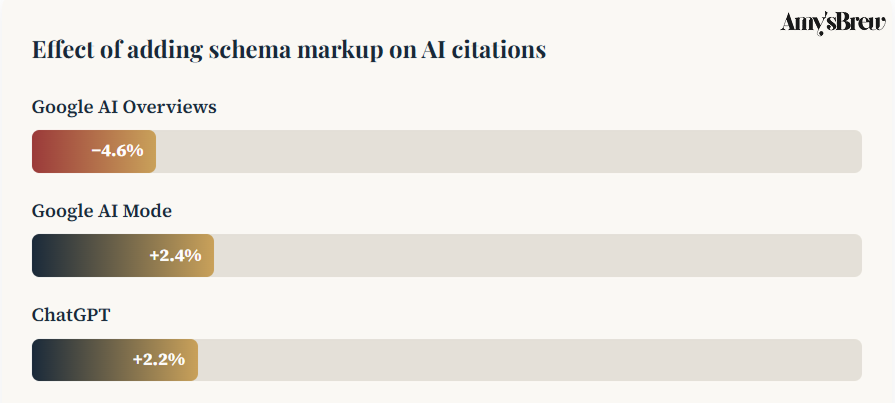
Source: Ahrefs, “We Tracked 1,885 Pages Adding Schema. AI Citations Barely Moved.” (2026). Ahrefs tracked 1,885 pages that added schema against 4,000 control pages already receiving 100+ AI citations. Adding schema produced no meaningful uplift on any platform, and a small but real decline on AI Overviews.
Schema still matters for helping search engines understand page entities and relationships, but it should support clear content rather than compensate for weak writing. For a broader view of how direct answers, structure, and schema work together, see this AEO strategy explainer.
4. Write Headings That Match Search Intent
Headings give search engines and AI systems strong clues about what each section answers. Query-aligned headings also make the page easier for human readers to scan, so they improve clarity without sacrificing readability.
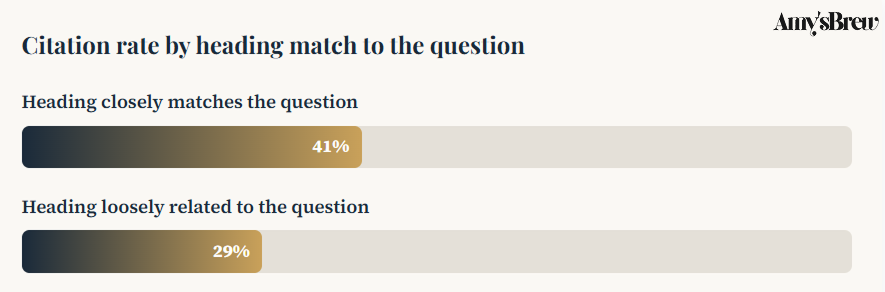
Source: AirOps, “The Fan-Out Effect: What Happens Between a Query and a Citation” (2026).
The takeaway is simple. If someone would search “how to write a SaaS content brief,” your heading should look close to that, not a clever title that only makes sense once you’ve read the paragraph under it.
AI Search Content Structure Checklist
Write headings as questions or clear statements
Match the way someone would actually search, not a clever turn of phrase.
Answer first, explain second
Put the direct answer in the first 40 to 60 words under every heading. Save the “why” for after.
One section, one idea
Don’t let a section wander between two different questions. It makes the answer harder to lift cleanly.
Cut the padding
If a paragraph doesn’t add a new fact or a new answer, cut it. Length isn’t the goal, clarity is.
Add schema for the right reason
Use it to help search engines understand your page and your brand. Don’t rely on it to earn AI citations.
Internal links should also connect this article to the next useful step in the reader’s journey. When the goal moves from visibility to pipeline, AmysBrew’s lead generation guide shows how AI can support qualification, prioritization, and conversion across B2B SaaS workflows.
Frequently Asked Questions About AI Search Content Structure
Does content structure matter more than the quality of the writing?
No. Structure decides whether AI tools can find and use your answer. Quality decides whether it’s worth citing in the first place. You need both.
Should I stop using schema markup?
No. Keep using it for traditional SEO and entity clarity. Just don’t treat it as an AI citation strategy on its own.
How long should a section be?
As long as it takes to answer the question clearly, and no longer. There’s no fixed word count to hit.
Does this replace the SEO structure I already use?
No. AI search optimization builds on SEO fundamentals. Clear headings, direct answers, useful internal links, and focused sections help human readers and traditional search while also making answers easier for AI systems to extract.
How do I structure content for ChatGPT and Google AI Overviews?
Use descriptive query-aligned headings, answer each section’s main question immediately, keep paragraphs focused on one idea, cite reliable sources, and connect related pages with contextual internal links. The goal is to make each important section understandable on its own.
What headings work best for AI search?
Headings that closely match the language and intent of the query work best. Use clear questions or descriptive statements such as “How to structure content for AI search” instead of clever headings that hide the section topic.
Want SaaS Content Built for Search and AI Citations?
I write and restructure SaaS content for traditional SEO, AI search visibility, and clear buyer journeys using research-backed claims and extractable page structure.





Leave a Comment