GEO vs AEO vs SEO: What SaaS Founders Need to Know Before Hiring a Content Writer
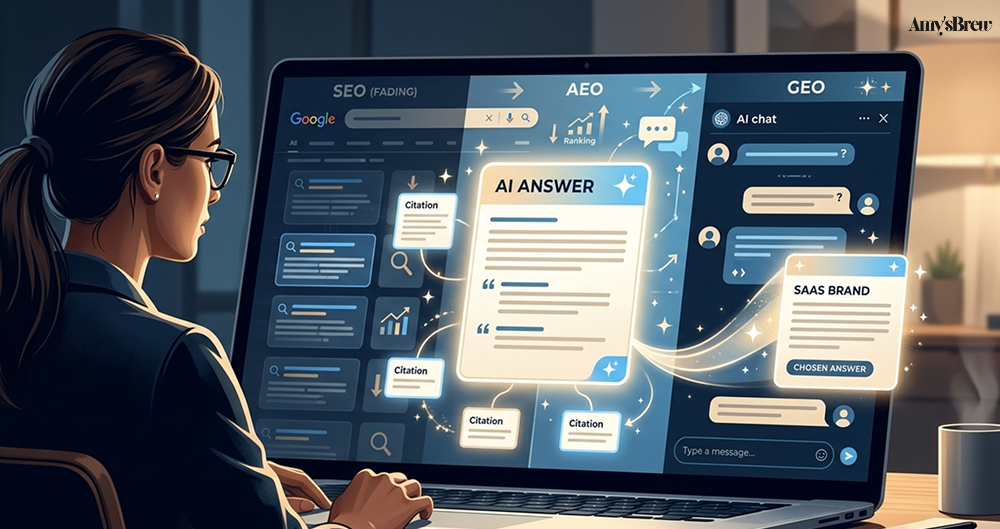
Every few months, a new acronym lands in the SaaS marketing world, and everyone scrambles to figure out what it means. First, it was SEO. Then AEO. Now GEO.
LET ME MAKE IT EASY FOR YOU!
If you are a SaaS founder or marketing lead trying to build a content strategy, you have probably seen all three and wondered whether they are actually different things or just the same idea with new branding.
They are genuinely different. Each one targets a different place where your buyers look for information. And if you are about to hire a content writer, you need to know which of these your content needs to do because not every writer understands all three.
This guide breaks down each term plainly, shows you where they overlap, and explains what the data says about where search is going. Every number here comes from a named, published source with a link you can check yourself.
Key Takeaways
- SEO, AEO, and GEO are three different disciplines — each targeting a different place where your buyers look for information.
- 58.5% of US Google searches in 2024 ended without a single click to any website, according to SparkToro’s zero-click study.
- Ahrefs’ December 2025 study of 300,000 keywords found that AI Overviews cut CTR for ranked pages by 58%, but pages cited as sources within an AI Overview can gain clicks. That is exactly what AEO optimizes for.
- 94% of B2B buyers now use AI in their buying process — generative AI was the single most cited research source in Forrester’s 2025 Buyers’ Journey Survey.
- 74.1% of B2B decision makers use ChatGPT for vendor research, followed by Gemini (59.5%) and Copilot (49.2%), according to ZeroClick Labs 2026.
- A content writer who understands all three disciplines produces content that ranks, gets cited by Google, and gets recommended by AI — from the first draft.
What Changed in Search and Why It Matters for SaaS
For most of the internet’s history, getting found online meant one thing: ranking on Google. You wrote content, Google indexed it, and people clicked through to your website. That model worked reliably for years.
Two things happened that changed the landscape for SaaS brands.
First, Google started answering questions directly. When Google introduced AI Overviews, it began giving users a summarised answer at the top of the results page — before they ever clicked a link. For anyone who had spent years building organic traffic, this was a significant shift.
Second, buyers started using entirely new platforms. ChatGPT, Perplexity, and similar AI tools became part of how people research before they buy. Your buyers are no longer only on Google.
“Your buyers are already using AI to research solutions like yours. The question is whether your content shows up when they do.”
The data makes the scale of this shift very clear. Here are the three numbers every SaaS founder building a content strategy needs to understand.
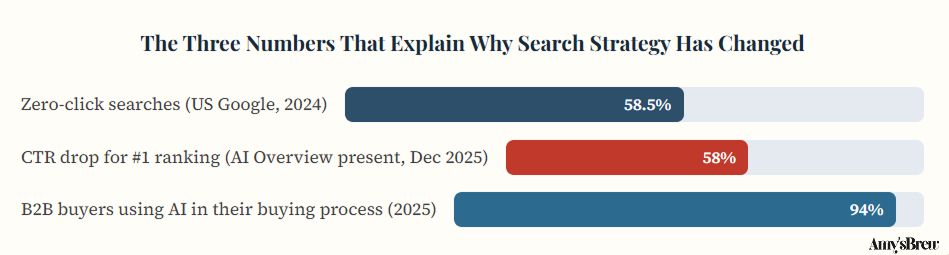
Zero-click search figure from SparkToro / Datos, 2024 Zero-Click Search Study. CTR drop figure from Ahrefs analysis of 300,000 keywords, December 2025. B2B buyer AI usage from Forrester Buyers’ Journey Survey, 2025.
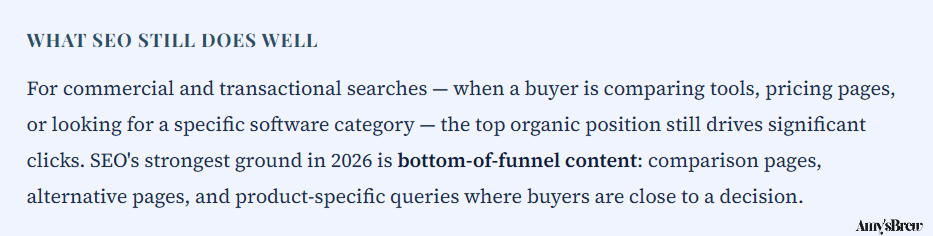
SEO is an Evergreen Foundation. Still Essential.
Search Engine Optimisation is the practice of making your content rank higher on Google and other search engines. You pick a keyword your buyers search for, write content that answers their question well, and structure the page so Google can read and rank it.
SEO has been around for decades and it still matters. Google processes significantly more searches per month than any AI platform. The difference is that ranking alone no longer guarantees traffic the way it used to — which is exactly why AEO and GEO became necessary disciplines alongside it.
For SaaS brands, SEO is your foundation. Before you think about AEO or GEO, your content needs to target real keywords your buyers search for, be well-structured, and be genuinely useful. Everything else builds on that base.
AEO: Writing for Google’s AI Overview Panel
Answer Engine Optimisation is the practice of structuring your content so that Google can extract a direct answer from it and display it at the top of the search results page in what is now called an AI Overview. The goal is not just to rank. It is to be the source Google quotes.
Here is why that distinction matters so much right now. When Google displays an AI Overview on a results page, most users read the AI-generated answer and never click through to any website.
Ahrefs tracked this across 300,000 keywords and found that click-through rates for the #1 ranked page dropped 58% between December 2023 and December 2025 — simply because an AI Overview appeared above the results. The chart below shows how that drop accelerated over time.
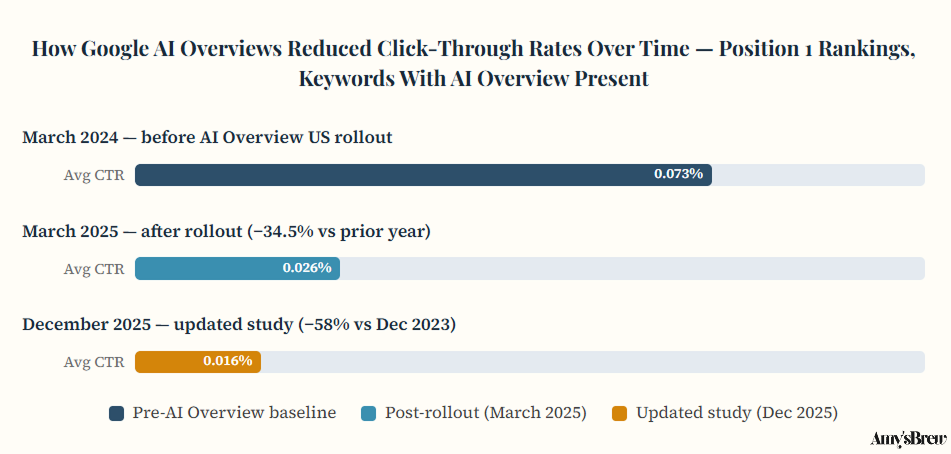
Average CTR for position-1 organic results on keywords that trigger a Google AI Overview. Source: Ahrefs, analysis of 300,000 keywords using Google Search Console data, April 2025 and December 2025. Bar widths scaled relative to the March 2024 baseline; percentage labels show actual CTR figures.
That is the problem AEO solves — and here is the key point that makes these two data points work together, not contradict each other.
Every ranked page loses clicks when an AI Overview appears. Except one: the page Google cites as its source inside that AI Overview. The same Ahrefs research found that cited pages can actually gain clicks, because some readers click the citation link to read the full article. So while everyone else’s traffic falls, the cited page benefits.
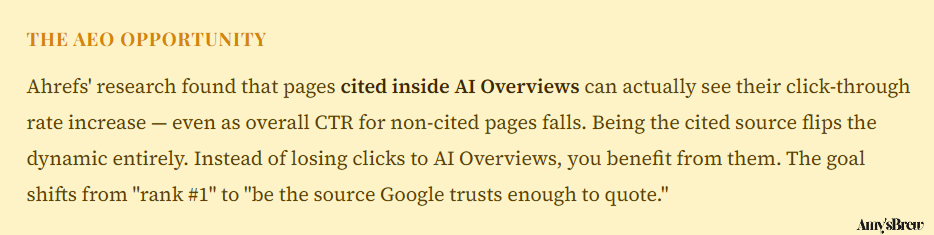
AEO is the practice of making your content the one Google trusts enough to quote. It leads with direct answers, uses question-and-answer formatting, and includes FAQ schema markup so Google can machine-read the structure clearly.
The complete picture in one sentence
GEO: Showing Up Inside ChatGPT, Perplexity, and Gemini
Generative Engine Optimisation is the newest of the three. It is the practice of making your content visible inside AI platforms like ChatGPT, Perplexity, and Google Gemini — not just on Google’s results page.
When a SaaS founder types “what’s a good B2B content writer for SaaS brands” into Perplexity, GEO is what determines whether your name comes up. It is not about ranking. It is about being cited, quoted, and recommended inside an AI-generated answer.
GEO-optimised content is factual, well-sourced, and entity-rich. It clearly establishes who you are, what you do, and who you serve. It earns third-party mentions — reviews, guest posts, expert citations — that give AI platforms independent signals to trust your content. And it keeps information current, because AI citation patterns shift regularly.
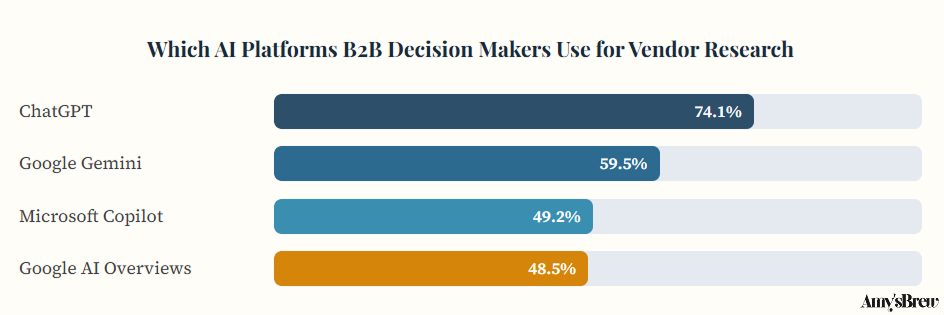
AI platform usage among B2B decision makers for vendor research and purchasing decisions. Source: ZeroClick Labs, AI Platform Popularity in B2B, 2026.
Three out of four B2B decision makers use ChatGPT. More than half use Gemini and Copilot. If your content does not show up in these platforms, a large portion of your buyers will not find you during their research phase — even if you rank perfectly on Google.
How the Three Relate to Each Other
SEO, AEO, and GEO are not competing strategies. They work on different surfaces and serve different moments in your buyer’s journey. A buyer might start their research by asking ChatGPT which SaaS content tools are worth using. That is GEO territory. They then search on Google for reviews and comparisons. That is SEO. When a specific question comes up and Google’s AI Overview appears, the source it cites is the AEO win.
All three can happen in a single buyer journey — often within the same hour.
“SEO gets you found when buyers search. AEO gets you quoted when Google answers. GEO gets you recommended when buyers ask AI.”
| Comparison Point | SEO | AEO | GEO |
|---|---|---|---|
| Where it appears | Google ranked results, also called blue links | Google AI Overview panel | ChatGPT, Perplexity, Gemini, Copilot |
| Primary goal | Rank in positions 1–10 | Be the cited source | Be recommended or quoted |
| Content format | Long-form, keyword-structured content | Direct Q&A, FAQ schema | Factual, entity-rich, well-sourced content |
| Drives direct clicks | Yes — this is the primary goal | Sometimes — depends on the query | Indirectly — influences decisions |
| Buyer stage served | Consideration and decision | Awareness and consideration | Awareness and discovery |
| Time to results | Typically 3–6 months | 4–8 weeks on established pages | Varies — citation patterns shift monthly |
| Priority order | Start here — it is the foundation | Layer on top of existing content | Build as your content library grow |
What the Data Shows About Where Search Is Going
There is a lot of noise about the death of SEO and the rise of AI search. The honest answer is more nuanced than either camp suggests.
Google still processes far more queries than any AI platform. Similarweb’s 2026 analysis found that AI search accounts for less than 1% of total web traffic for most B2B SaaS companies.
But Forrester’s Buyers’ Journey Survey 2025 found that 94% of B2B buyers are already using AI in their buying process. Less than 1% of the traffic — but 94% of the buyers. AI platforms influence decisions even when they do not drive clicks.
As the CTR data in the AEO section above shows, the traffic impact is real and accelerating. A page that ranked #1 in early 2024 is now receiving less than a quarter of those clicks on keywords where an AI Overview appears. This does not mean SEO is dead. It means the strategy needs to expand to capture visibility across all three surfaces — not just Google’s ranked list.
The trend is consistent and accelerating. A page that ranked #1 and received reasonable traffic in early 2024 is now receiving less than a quarter of those clicks, simply because an AI Overview appears above it.
This does not mean SEO is dead. It means the strategy needs to expand to capture visibility beyond the ranked list.
What This Means When You Are Hiring a Content Writer
Most content writers can do one of these three things reasonably well. Fewer can do two. Very few think about all three from the start of a content project — which is where most SaaS content budgets quietly leak.
For SaaS brands, this matters because your content needs to do more than rank. It needs to be structured so Google can extract answers from it. It needs to be factual and well-sourced enough that AI platforms are willing to cite it. And it needs to actually be useful to a buyer who reads it because that is what earns trust regardless of which surface they find it on.
When you brief a content writer, here is what to ask:
- Do they do keyword research before writing? Or do they write first and optimise later? The right answer is research first, always.
- Do they lead with the direct answer? AEO-ready content puts the key answer in the first paragraph, not buried in paragraph five.
- Do they cite real, named sources? Content that can be verified is content that AI platforms are willing to quote. Vague statistics are a red flag.
- Do they think about what buyers ask AI, not just Google? The two are different questions, written differently, and a good writer knows the difference.
- Do they understand the difference between ranking and converting? Traffic that does not produce enquiries is a cost, not an asset.
A writer who can answer yes to all five is thinking across SEO, AEO, and GEO, even if they do not use those terms. That is the writer worth hiring.
Where to Start as a SaaS Founder
If you are early in building a content strategy and feel overwhelmed by these three terms, here is the practical order of operations.
Start with SEO fundamentals. Before anything else, your content needs to target real keywords your buyers search for and be structured well enough for Google to index. This is the foundation everything else sits on. Without it, AEO and GEO have nothing to build on.
Then add AEO on top. Once you have content that ranks, optimise it to be extractable. Add FAQ sections. Lead each section with a direct answer. Apply FAQ schema markup. This turns existing content into AI Overview citations — faster and cheaper than building new content from scratch.
Summary: Three Disciplines, One Content Strategy
- SEO gets your content ranking on Google’s blue links. It is still the foundation of any B2B SaaS content strategy and the right place to start.
- AEO gets your content cited inside Google’s AI Overview panel. It turns your existing pages into sources Google quotes — building visibility even as overall click-through rates decline.
- GEO gets your content recommended inside ChatGPT, Perplexity, Gemini, and similar AI platforms. It is where your buyers increasingly begin their research before they ever open Google.
A SaaS brand that understands all three and hires a writer who does too is building a content strategy for where search is now, not where it was five years ago.
Frequently Asked Questions
What is the difference between SEO and AEO?
SEO focuses on helping your content rank in Google’s traditional search results, also known as SERPs or blue links. AEO focuses on helping your content get cited inside Google’s AI Overview, featured snippets, and direct-answer sections. SEO aims to win the click. AEO aims to become the answer Google trusts enough to show before the click. For SaaS brands, both matter because buyers may either click a ranked result or rely on the AI-generated summary before choosing which brand to explore.
Is SEO still worth investing in for SaaS in 2026?
Yes. SEO is still worth investing in for SaaS because Google SERPs continue to drive high-intent traffic, especially for comparison pages, alternative pages, product-led articles, and bottom-of-funnel searches. What has changed is that SEO alone is no longer enough. SaaS content now needs to be structured for both traditional rankings and AI Overview visibility. A strong SaaS SEO strategy should help your content rank in search results, get cited in AI answers, and convert buyers who are already comparing solutions.
What is GEO and how is it different from SEO and AEO?
GEO, or Generative Engine Optimisation, focuses on making your brand visible inside AI platforms such as ChatGPT, Perplexity, Gemini, and Copilot. SEO targets Google’s organic SERPs. AEO targets Google’s AI Overview and answer-style results. GEO targets generative AI tools that recommend, summarise, and compare brands for users. For SaaS companies, GEO matters because buyers are increasingly using AI tools to research vendors before they ever visit a website or search on Google.
How does a content writer approach SEO, AEO, and GEO differently?
For SEO, a content writer targets keywords, search intent, headings, internal links, and ranking opportunities in the SERP. For AEO, the writer gives direct answers, uses question-based sections, adds FAQs, and structures content so Google can extract clear answers for AI Overviews. For GEO, the writer makes the content factual, source-backed, entity-rich, and easy for AI platforms to understand. The best SaaS content writer does not treat these as separate tasks. They write one article that can rank in Google, appear in AI Overviews, and be understood by generative AI platforms.
Should a SaaS startup prioritise SEO, AEO, or GEO first?
A SaaS startup should start with SEO because keyword research, search intent, and strong on-page structure are the foundation. Once the page is SEO-ready, AEO should be added through direct-answer sections, FAQ formatting, and schema markup so the content has a better chance of appearing in Google AI Overviews. GEO should be built alongside this by making brand information clear, using credible sources, and creating content that AI platforms can understand and reference. The best order is: SEO first, AEO next, GEO as an ongoing visibility layer.