Digital PR for B2B SaaS: A Campaign System for Earned Coverage and Authority

Digital PR for B2B SaaS is the work of earning relevant attention for a useful idea, expert perspective or piece of evidence. The best campaigns give journalists, analysts, podcast hosts and industry editors something they can use with their audiences. A link may follow, but a link count by itself does not tell you whether the campaign reached the right people or improved trust in the brand.
For a SaaS company, the challenge is often not a shortage of product information. It is finding a story that matters beyond the product team, proving it responsibly, and presenting it in a form that a publisher can assess quickly.
This guide lays out a repeatable campaign process. It focuses on editorial relevance, evidence quality, and the operational steps between an idea and earned coverage. It does not repeat AmysBrew’s existing AI visibility articles: use its LLM brand visibility audit or guide to controlling how LLMs describe your brand for the separate audit and source-gap questions.
The short answer
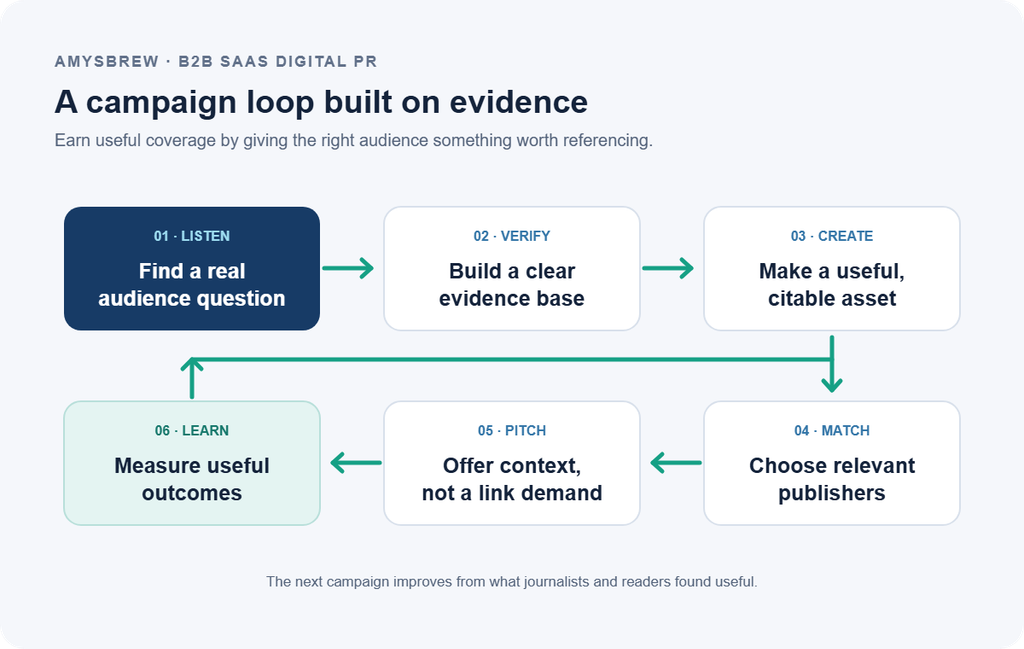
Start with a question your target audience already cares about. Create a genuinely useful answer supported by verifiable evidence. Make a concise, accessible asset and source pack. Identify a small group of relevant publishers or experts. Pitch each one with a specific reason their audience would care. Then measure coverage, referral attention, brand search and useful follow-on effects—not only backlinks.
Digital PR can support reputation, discovery, relationships and organic authority at once. It cannot guarantee a specific placement, link, ranking or pipeline result. The publisher controls its coverage and links; the campaign team controls the quality of its story and execution.
Infographic: the B2B SaaS digital PR campaign loop
What digital PR is—and what it is not
Digital PR uses public relations thinking in digital channels. It aims to make a company, expert or idea relevant to people who influence a market. Work may include original research, expert commentary, product or customer stories, useful tools, data visualisations, podcasts, industry briefings and carefully targeted media outreach.
Link building is one possible outcome, but it is not a synonym for every PR activity. A journalist may mention a company without linking to it. A podcast may introduce an expert to a relevant audience but provide no link at all. A link from a specialist publication may send fewer visitors than a general news site but reach far more qualified readers.
| Activity | Primary purpose | What a strong result may look like |
|---|---|---|
| Digital PR | Earn relevant coverage and public credibility | Meaningful article, expert quote, podcast, data reference or useful link |
| Link building | Improve discovery and authority by earning relevant links | Editorial links from pages and sites that make sense for the subject |
| Paid sponsorship | Buy distribution or placement | Clearly disclosed paid exposure with sponsored links qualified appropriately |
| Guest contribution | Share an expert contribution with another publication’s readers | Original, high-quality editorial content that suits the publisher’s audience |
| Affiliate promotion | Reward a partner for a trackable referral or sale | Clear commercial disclosure and properly tracked referral activity |
These activities can overlap, but their purpose and disclosure should remain clear. A paid placement should not be disguised as independent editorial coverage.
Why SaaS companies need a different story approach
B2B software can be technically complex, and product features are not automatically news. A new dashboard, integration or AI feature may matter to customers but offer little reason for an unrelated editor to cover it. The PR question is: what does this development help an audience understand, decide or do?
The strongest stories often translate product knowledge into an audience problem:
- What is changing in the way a specialist team works?
- Where are practitioners losing time, budget or reliable information?
- What does the current evidence say—and what does it not say?
- Which trade-off are buyers routinely missing?
- What has your team learned that could help a broader group of operators?
The story needs to stand without the sales pitch. The company can be the source, researcher or practitioner, but the reader should receive a useful answer even if they never visit a product page.
Choose a campaign angle with a story test
Before commissioning a survey or building a report, score a few ideas. The goal is not mathematical certainty; it is a disciplined way to reject ideas that are only interesting to the company.
| Test | Ask | Strong signal | Weak signal |
|---|---|---|---|
| Audience relevance | Who will care about the result? | A specific role or industry has a reason to act on it | “Everyone in business” is the audience |
| Novelty | What would a reader learn that is hard to find elsewhere? | New data, a useful method, a clear expert explanation | The claim is already common knowledge |
| Evidence | Can each main statement be checked? | Source, date, sample, definitions and caveats are documented | The conclusion relies on an unattributed statistic or anecdote |
| Timing | Why is this useful now? | A market change, planning moment or meaningful new finding | The only urgency is an internal launch date |
| Independence | Would the result still be useful if it did not praise the product? | The findings can be mixed, surprising or inconvenient | The campaign only works if the brand wins every comparison |
| Format | Can an editor use it quickly? | Clear summary, charts, source notes and an available expert | The pitch asks the editor to read a long sales deck |
If an idea fails the relevance or evidence test, refine it before production. A polished visual cannot rescue a weak question.
Campaign formats that can fit B2B software
Not every SaaS PR campaign needs a large annual survey. Match the format to what you can prove and what your team can maintain.
| Campaign format | What makes it useful | Evidence or material needed | Example outlet fit |
|---|---|---|---|
| Original research | Answers a meaningful industry question with new analysis | Sound methodology, reliable data, definitions and limitations | Trade press, analyst newsletters, business publications |
| Expert commentary | Adds a clear, informed perspective to a current story | Available subject expert, specific point of view, supporting facts | Journalists seeking comment, podcasts, specialist blogs |
| Customer or workflow case | Shows what changed for a real team and under what conditions | Customer consent, baseline, time period, implementation details | Vertical publications, practitioner communities |
| Technical explainer or benchmark | Helps readers understand a complex system or decision | Reproducible method, assumptions, code or technical review if relevant | Developer media, technical newsletters, industry events |
| Useful tool or data visual | Makes a complicated task or dataset easier to use | Tested calculations, transparent inputs, accessible design | Resource pages, newsletters, partner content |
| Reactive insight | Explains what a timely event means for practitioners | Fast access to an expert and facts that can be checked | News desks, trade media and current-affairs podcasts |
The examples are formats, not promises of coverage. A survey is only useful if the sample and question support the conclusion. An expert opinion is only useful if it adds information beyond “this trend is important.”
Design original research people can trust
Research can create a strong PR asset, but it carries responsibilities. Decide the research question before collecting data. Define the population you want to understand, how respondents or records will be selected, what the analysis can support, and what limits will remain.
Write the method before the headline
Create a short methodology note before fieldwork starts. Include:
- The precise question the study is designed to answer.
- Who or what is included in the sample, and how they were recruited or selected.
- The fieldwork dates and geography.
- The number of responses or records after cleaning.
- Definitions for terms that could be interpreted in different ways.
- Exclusions, missing data and known limitations.
- Who reviewed the analysis and how calculations can be checked.
This prevents the headline from outrunning the evidence. If a survey only includes customers, say so. If participants self-selected, do not imply the result represents an entire profession. If a dataset measures product usage, do not claim it measures the whole market.
Protect privacy and permission
Do not publish customer, user or employee data just because it is technically available. Confirm legal basis, consent, contractual rights, aggregation thresholds and re-identification risk with the appropriate privacy or legal reviewer. Remove personal information that is not necessary to explain the finding.
If a customer story is involved, agree on what can be named, which metrics can be quoted, how the customer will review factual details, and where the final material may appear. Never imply a customer endorsement that the customer did not provide.
Present the finding and the caveat together
Readers should not have to search the footnotes to learn that a figure is an estimate, a small sample or a self-selected poll. Put essential caveats beside the chart or claim. That reduces the chance that a correct number is repeated incorrectly after it is quoted out of context.
Build a press-ready evidence page
The campaign page should work for three visitors: a journalist checking a claim, a practitioner trying to understand the result, and a reader arriving from a link. Give them enough to assess the asset without contacting sales.
| Page element | Include | Avoid |
|---|---|---|
| Headline and summary | The finding, audience and timeframe in plain language | A vague claim such as “The future has arrived” |
| Key findings | A small number of accurately worded results | A long list of disconnected percentages |
| Methodology | Sample, dates, definitions, collection and limitations | “We surveyed industry leaders” with no explanation |
| Data visual | Readable chart with source and labels | A decorative chart that obscures the underlying numbers |
| Downloadable material | Dataset or report when appropriate and safe | Requiring a journalist to submit a lead form for basic facts |
| Expert contact | Named, available spokesperson and relevant expertise | A generic “contact us” route with no response owner |
| Company context | A concise description of the research sponsor and why it is involved | An overlong company history or product pitch |
| Update details | Publication date and corrections contact | Cosmetic date changes without substantive updates |
For technical data, provide a stable source note and, where useful, a machine-readable CSV or methodology appendix. For survey findings, show the exact wording of questions that could affect interpretation. The page should be accessible on mobile and should not hide its central findings inside an image.
Find the right publishers before you write the pitch
Build a modest, research-led media list. Identify publications, newsletters, podcasts, analysts and professional communities that reach the people affected by the story. Then learn how each one handles the topic.
| Prospect type | What to research | Outreach angle |
|---|---|---|
| Trade journalist | Recent coverage, beat, preferred evidence and deadline patterns | A relevant finding or available expert that extends their beat |
| Industry newsletter | Audience roles and editorial format | A concise takeaway, chart or practitioner lesson readers can use |
| Podcast host | Guest topics, episode length and audience level | An expert who can explain a useful tension or lesson in depth |
| Analyst or research publisher | Existing frameworks, data standards and coverage gaps | A transparent dataset, methodology or informed contribution |
| Professional community | Rules, moderation and community needs | A direct contribution that helps members; follow promotion rules |
| Partner or integration ecosystem | Shared customer needs and editorial guidelines | A useful implementation or research angle, with commercial ties disclosed |
Do not treat a large media list as a campaign outcome. A carefully chosen group of relevant contacts is often more useful than sending the same message to hundreds of people who cover unrelated topics.
Write a pitch that respects the editor’s time
A good pitch answers four questions quickly: why this recipient, what is the story, why now, and what evidence or access is available? Put the strongest finding near the top and make it easy to verify.
A concise pitch structure
- Subject: State the topic or finding clearly.
- Personal relevance: Mention a recent piece or the specific audience you believe this serves.
- News point: Share the most useful finding in one or two sentences.
- Evidence: Link to the methodology or press page and state any important limitation.
- Offer: Make an expert available or provide a chart, data extract or interview.
- Close: Ask a simple, low-pressure question and include contact details.
Do not paste the entire report into the email. Do not pretend the editor has covered something they have not. Avoid claiming an asset is exclusive if it has already been distributed widely, and honour exclusivity agreements when you make them.
Example pitch template
Subject: New [industry] analysis: [specific finding] among [sample]
Hi [Name],
I read your recent coverage of [specific topic] and thought this finding might be useful for your [audience/beat]. AmysBrew analysed [plain description of dataset or survey] collected during [timeframe]. The clearest result was [one accurate finding], with the important caveat that [limitation, if relevant].
The methodology and chart are here: [press-page link]. [Expert name and role] can explain what the result means for [audience] and is available for a short interview. I can also send the underlying table or walk through the method.
Would this be useful for an upcoming piece?
Best,
[Name and contact details]
This is a starting structure, not text to mass-send. Replace every bracket with specific, accurate information and remove any sentence that does not help this editor assess the story.
Follow up without turning outreach into spam
If there is no reply, one short follow-up can be reasonable when it adds something useful: a fresh data point, a newly available expert, or a clear correction. Do not send a sequence of “just checking in” messages or switch channels repeatedly after a clear no.
Keep a simple record: recipient, publication, beat, date, angle pitched, response, next action, and any opt-out or preference. Respect requests not to be contacted. Follow applicable email and privacy rules for the sender’s and recipient’s jurisdictions; this is an operational requirement, not an optional campaign flourish.
Measure the work across more than backlinks
Separate outputs, audience response and business signals. This avoids the false choice between “PR is only awareness” and “every link instantly drives revenue.”
| Measurement layer | Example measures | What the measure can tell you | What it cannot establish alone |
|---|---|---|---|
| Campaign output | Pitches sent to relevant contacts, responses, interviews, coverage | Whether the campaign reached its intended editorial targets | Whether the coverage changed revenue |
| Coverage quality | Accuracy, audience relevance, expert attribution, article context | Whether the story appeared in a useful place and represented the evidence fairly | A universal SEO value for each placement |
| Links and citations | Linking page, destination, anchor context, live status | Whether coverage points readers to a useful resource | That a link caused a ranking change |
| Audience response | Referral sessions, engaged visits, newsletter signups where consented | Whether coverage brought an interested audience to owned pages | Whether every visit is commercially qualified |
| Brand and demand signals | Branded queries, direct traffic trends, inbound mentions, qualified enquiries | Whether attention appears to be increasing around the campaign period | Causation without a suitable study design |
| Business contribution | CRM leads, influenced opportunities, sales usage, pipeline context | Whether the asset is useful in commercial conversations | Precise attribution if the journey is multi-touch or tracking is incomplete |
Record the campaign date, baseline period, target audience and measurement window. Compare like with like where possible. Report what changed and what remains uncertain instead of turning correlation into a case-study claim.
Link earning and Google’s policies
Google says links can help it discover pages and understand relevance, and its spam policies identify buying links for ranking purposes, excessive link exchanges, automated link schemes and paid articles that pass ranking credit as link spam. Paid advertising or sponsorship can still be legitimate when links are appropriately qualified with rel="sponsored" or nofollow.
For this reason, the campaign should not promise publishers a reciprocal link, offer compensation in return for an unqualified ranking link, or make optimized anchor text a condition of coverage. Ask for factual accuracy and fair attribution; let the publisher decide whether a link belongs and how it should be written.
The distinction is practical: pursue real coverage because its audience and context matter. When links are earned as a by-product of useful editorial work, the story can remain worthwhile even if a publisher chooses not to link.
An eight-week campaign timeline
The length depends on research, approvals and publisher schedules. This sample sequence helps a small team see the work involved without promising a fixed coverage result.
| Week | Main work | Decision gate |
|---|---|---|
| 1 | Select audience question, campaign objective and format | Is the topic relevant beyond the company? |
| 2 | Confirm research method, data access, privacy and review owners | Can the evidence safely support the intended claim? |
| 3–4 | Collect or analyse evidence; validate calculations and limitations | Do the findings answer the original question? |
| 5 | Build the press page, charts, expert notes and source pack | Can an editor verify and use the asset quickly? |
| 6 | Research outlets and prepare tailored pitches | Does each target have a clear audience fit? |
| 7 | Conduct focused outreach and make experts available | Are responses and questions being handled promptly? |
| 8 | Follow up appropriately, log coverage and review results | What should be repeated, changed or stopped next time? |
Some campaigns take longer. If data collection or approvals are not ready, move the campaign date instead of rushing out an unsupported claim.
Common B2B digital PR mistakes
Starting with the backlink target
If the only reason for a campaign is to place a link to a commercial page, the story is likely to feel forced. Start with an audience need; let the most useful source page be the destination.
Treating proprietary data as automatically newsworthy
Product data can be valuable, but the sample may only describe a particular user base or product workflow. Define the population and limitations clearly. Do not generalise beyond the evidence.
Pitching the same release to every outlet
The same finding can be framed differently for a finance audience, a developer publication and a technology leadership podcast. Tailor the angle without changing what the data says.
Overstating campaign results
Do not imply that a single placement caused ranking, revenue or AI citation changes unless the evidence supports that causal claim. Keep client-provided results labelled as such and separate campaign metrics from third-party estimates.
Measuring only domain metrics
Domain-level scores from SEO tools can be useful directional metrics but are not outcomes by themselves. Include audience relevance, referral value, accurate coverage, brand signals and commercial follow-through.
Publishing an asset and moving on
Make the page easy for sales, customer success and the founder to use. Reuse the findings in talks, newsletters or product education when appropriate, but preserve the original methodology and link to the full source.
FAQs about digital PR for B2B SaaS
What is digital PR for B2B SaaS?
It is a programme of earning relevant online coverage for a SaaS company’s expertise, research, product context or customer learning. The goal is useful visibility and credibility with the audiences that matter; editorial links may be one outcome.
Is digital PR the same as link building?
No. Digital PR is a broader public relations activity. Link building focuses on earning links. A digital PR campaign can earn links, mentions, interviews, referral visits or useful relationships, and some coverage may not include a link.
What makes a good SaaS digital PR campaign?
A good campaign begins with a real audience question, uses defensible evidence, provides a clear and useful asset, reaches relevant publishers with tailored context, and reports results honestly.
Does digital PR guarantee backlinks or rankings?
No. Publishers make their own editorial decisions, and search rankings depend on many factors. A campaign can improve access to a relevant audience and earn coverage, but no agency or company can guarantee a particular link or ranking.
Should a company pay for links in digital PR?
Companies may pay for advertising or sponsorship, but those placements should be disclosed and links qualified appropriately. Buying links that pass ranking credit or conditioning payment on optimized editorial links conflicts with Google’s link spam policies.
How do you measure digital PR ROI?
Set a goal and baseline first. Track coverage quality, links and citations, referral attention, brand or demand signals, and CRM outcomes where available. State the time period and attribution limits; avoid crediting the entire change to one placement without evidence.
What data can a SaaS company use for PR?
Potential sources include a properly designed survey, anonymised product usage data with permission, public datasets, expert analysis, customer stories with approval, and reproducible technical analysis. The method, sample and limitations should be clear before publication.