Purple Cow Marketing: How to Make B2B Content Marketing and Social Media Marketing Impossible to Ignore

Most B2B brands are not failing because their product is bad. They are failing because nobody notices them. The Purple Cow marketing technique offers a simple fix: stop trying to be good, and start trying to be remarkable.
Scroll through LinkedIn on any weekday morning and you will see the problem. Dozens of SaaS companies promise “seamless, scalable, AI powered solutions.” Hundreds of blogs publish the same “10 tips” listicle with a different stock photo. Every brand sounds competent, and almost none of them are memorable.
That is exactly the world Seth Godin described in his 2003 book Purple Cow: Transform Your Business by Being Remarkable. Two decades later, his idea matters more than ever, especially for B2B content marketing and social media marketing, where attention is the scarcest resource a brand can earn.
In this guide, we break down what the Purple Cow technique really means, why it works, and how you can apply it to your content and social channels without resorting to gimmicks. If you want the full planning framework behind it, start with our B2B content marketing strategy guide for SaaS.
Key Takeaways
- A Purple Cow is a product, idea or piece of content so different that people feel compelled to talk about it.
- In crowded markets, “very good” is invisible. Playing it safe is the riskiest strategy of all.
- Remarkable marketing is built into the product or content itself, not bolted on afterwards with ad spend.
- Target the small group of early adopters and “sneezers” who spread ideas, not the entire market at once.
- In B2B content marketing, original data, strong opinions and genuinely useful tools create Purple Cows far more often than generic blog posts.
- In social media marketing, a distinctive voice, native formats and a bold first line matter more than posting frequency.
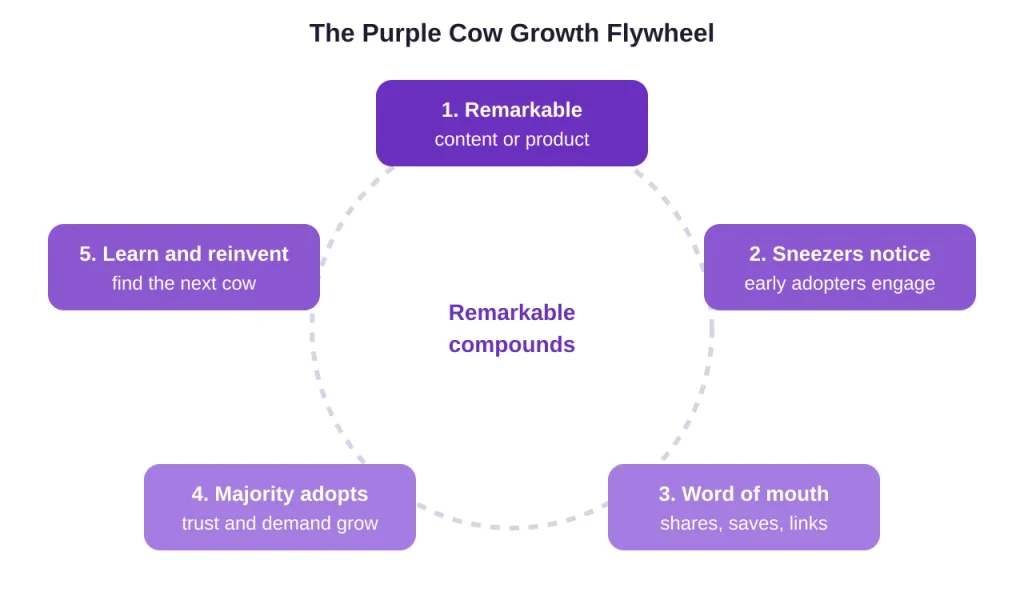
- Every Purple Cow eventually turns brown, so successful brands milk their advantage and then reinvent.
What Is the Purple Cow Marketing Technique?
The name comes from a road trip. Godin was driving through the French countryside with his family, and at first everyone was delighted by the cows grazing beside the road. Within twenty minutes, nobody was looking anymore. The cows had become background.
But a purple cow? Everyone would stop, point and tell someone about it.
That is the heart of the technique. Your brand is either a brown cow that blends into the landscape, or a purple cow that people cannot help noticing. Godin uses the word “remarkable” in its literal sense: something worth making a remark about. Quality on its own does not guarantee that. Plenty of excellent products die quietly because nothing about them gives people a reason to share.
Why “Very Good” Is No Longer Good Enough
For most of the twentieth century, marketing followed a predictable formula. Build an average product for an average customer, then buy mass attention through television, print and radio. Godin called this the “TV industrial complex,” and he argued that it had stopped working.
The reasons are even stronger today:
- Buyers are overwhelmed. B2B decision makers face a constant stream of emails, ads, webinars and sponsored posts. Most of it is ignored by default.
- Buyers research on their own. Much of the B2B buying journey happens before a prospect ever speaks to sales, through search, peer recommendations and social feeds.
- Algorithms reward engagement. On social platforms, forgettable content is not just ignored by people. It is quietly buried by the feed.
In this environment, Godin’s most counterintuitive claim makes perfect sense: safe is risky. The cautious, committee approved message that offends nobody also excites nobody. Being boring is not a neutral choice. It is a slow way to disappear.
The Core Principles of Purple Cow Marketing
1. Marketing starts with the product
Godin argues that marketing is no longer something you do after the product is finished. The remarkable element should be designed in from the start. For content marketers, this means the idea itself must be worth sharing before you think about distribution.
2. Find the sneezers
Not everyone spreads ideas equally. Godin borrows from diffusion of innovation theory, which divides any market into groups based on how quickly they adopt something new. The early adopters, whom Godin calls “sneezers,” are the people who actively seek out new ideas and pass them along to colleagues and followers.
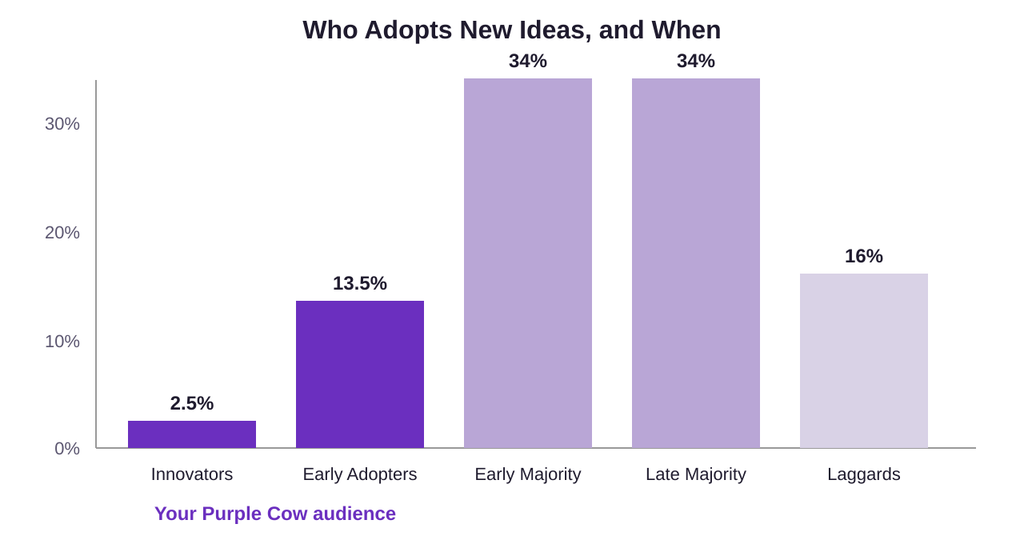
The lesson is clear. Do not design your content for everyone. Design it for the curious, opinionated minority who will share it, and let them reach the majority for you.
3. Serve the obsessed
Godin points to the “otaku,” a Japanese term for people who are deeply obsessive about a subject. In B2B, these are the practitioners who read every industry newsletter, test every new tool and argue about best practices in comment threads. Win them over and you gain a network of credible advocates.
4. Milk it, then reinvent
Remarkable things do not stay remarkable forever. Once competitors copy your approach, your purple cow fades to brown. Godin’s advice is to profit from your advantage while it lasts and reinvest in finding the next one.
Brown Cow vs Purple Cow: A B2B Comparison
Here is how the difference plays out across common B2B content marketing and social media marketing decisions.
| Area | Brown Cow Approach | Purple Cow Approach |
|---|---|---|
| Blog content | Rewritten “top tips” posts that match what already ranks | Original research, first hand experiments and a clear point of view |
| Brand voice | Corporate, cautious and full of buzzwords | Distinctive, human and willing to take a position |
| Social posts | Link drops and product announcements | Native posts with a strong hook, a story or a useful insight |
| Lead magnets | Generic e-books gated behind long forms | Free tools, templates or calculators people actually use daily |
| Audience | Everyone who might ever buy | Early adopters and practitioners who share ideas |
| Success metric | Impressions and output volume | Shares, saves, mentions and backlinks earned |
How to Apply Purple Cow Thinking to B2B Content Marketing
B2B content marketing is one of the most crowded spaces online. Search results for almost any software topic are filled with near identical articles. That sameness is your opportunity.
Publish data nobody else has
Original research is one of the most reliable ways to become remarkable. Survey your customers, analyse anonymised product data or run your own experiments. Proprietary insights give journalists, bloggers and analysts a reason to cite you, which also builds the backlinks that support your SEO. Pair your research with a digital PR campaign for B2B SaaS to put it in front of the right publications. New to search? Our guide on what SEO means for businesses covers the basics.
Take a clear position
Content that says “it depends” on every question rarely gets shared. Content that challenges a popular assumption, backed by evidence and experience, sparks conversation. You do not need to be controversial for its own sake. You simply need to say something your audience has not heard a hundred times.
Build something useful
Free tools such as graders, calculators, checklists and templates often outperform articles because people return to them and recommend them to colleagues. The tool itself becomes the marketing, and it doubles as a lead source. See our guide to AI lead generation for B2B SaaS for ways to connect tools like these to your pipeline.
Go deeper than anyone else
Sometimes the remarkable move is depth. A guide that genuinely answers every question a practitioner has, with real screenshots, examples and lessons learned, stands out against thin content written only to rank. It is also the kind of content AI search tools prefer to cite, which we explore in our guide to creating AI ready content.
Make the format part of the message
Remember the Dutch Boy paint example from Godin’s book: the company did not change the paint, it redesigned the can. In content, a familiar topic told through an interactive explainer, a teardown video or a visual story can feel entirely new.
Purple Cow Social Media Marketing
Social media marketing is where the Purple Cow principle is tested most brutally. A post has seconds to earn attention before the thumb keeps scrolling. Here is how to make yours stop people in their tracks.
- Lead with a pattern interrupt. Your first line or first two seconds of video should surprise, challenge or intrigue. Generic openers are skipped instantly.
- Be native, not recycled. A short video built for reels feels different from a cropped webinar clip. Each platform rewards content that feels like it belongs there.
- Put people in front of the brand. Founders, engineers and customer facing staff sharing real experiences often outperform polished brand accounts in B2B.
- Own a recognisable style. A consistent visual identity, a recurring series or a signature format trains your audience to recognise you instantly. A consistent identity also shapes how AI assistants describe you, as covered in how to control what LLMs say about your brand.
- Start conversations, not broadcasts. Ask questions, reply to comments and engage with the sneezers in your niche. Social platforms are built for dialogue.
Purple Cow Ideas by Channel
| Channel | Purple Cow Idea | Why It Gets Noticed |
|---|---|---|
| Founder posts sharing real numbers, failures and lessons | Honesty is rare in B2B feeds and invites discussion | |
| Instagram Reels | Fast, visual myth busting of industry jargon | Turns dry B2B topics into entertaining, shareable clips |
| YouTube | Unscripted product teardowns or live builds | Shows expertise instead of claiming it |
| X (Twitter) | Threads breaking down a competitor’s or industry strategy | Practitioners love sharing sharp analysis |
| Company blog | Annual original research report | Earns citations, backlinks and media coverage |
Real World Purple Cows Worth Studying
Basecamp built a loyal following in project management partly by being openly opinionated about calm work culture, a stance that stood out in a category obsessed with hustle.
Mailchimp brought a playful, illustrated personality to email marketing, a category that had traditionally felt technical and dry.
Slack grew as teams invited colleagues into a product people genuinely enjoyed using. The product spread through its own users.
HubSpot popularised free tools and educational content as a way to attract marketers long before they were ready to buy, making helpfulness its signature.
None of these brands relied purely on advertising. Each one built something people wanted to talk about.
Common Mistakes to Avoid
- Confusing remarkable with gimmicky. A stunt with no connection to real value creates a spike, not a reputation.
- Copying someone else’s Purple Cow. The second brand to do something unusual is just following. Find the angle that is genuinely yours.
- Diluting the idea by committee. Bold concepts often get softened until they are safe again. Protect the part that makes it different.
- Forgetting execution. A remarkable idea delivered poorly becomes a famous failure. Quality still matters.
- Standing still. What felt fresh last year may be standard practice now. Review and reinvent regularly.
How to Find Your Own Purple Cow: A Simple Process
- Audit the sameness. Review the top competitors’ blogs and social feeds. List every pattern they share.
- Talk to your sneezers. Interview your most engaged customers and followers. Ask what they wish someone in your industry would say or build.
- Pick one extreme. Decide to be the most transparent, the most practical, the most data driven or the most entertaining voice in your niche.
- Prototype small. Test the idea with a single post, video or report before committing a full campaign. Once it works, fold it into your B2B SaaS SEO content roadmap.
- Measure remarkability. Track shares, comments, saves, mentions and backlinks, not just reach. For a real example of what to measure, see our SaaS content strategy results after three months.
- Scale and reinvent. Double down on what spreads, and start scouting for your next Purple Cow before this one fades.
Frequently Asked Questions
What is the Purple Cow marketing technique in simple terms?
It is the idea, introduced by Seth Godin, that businesses should build products, services and content that are so distinctive people naturally talk about them, rather than relying on advertising to promote something ordinary.
Does Purple Cow marketing work for B2B companies?
Yes. B2B buyers are still people, and they share ideas that impress or help them. In B2B content marketing, original research, strong opinions and useful free tools are some of the most effective ways to become remarkable.
How does the Purple Cow concept apply to social media marketing?
On social platforms, remarkable content earns attention and engagement, which algorithms then reward with more reach. A bold hook, a distinctive voice and platform native formats help your posts stand out in crowded feeds.
Is being remarkable the same as being controversial?
No. Controversy can attract attention, but remarkability is about delivering something worth discussing. Exceptional usefulness, honesty, design or depth can all make a brand remarkable without provoking anyone.
How long does a Purple Cow advantage last?
Usually until competitors copy it. Once a distinctive approach becomes common, it stops standing out. That is why Godin advises brands to profit from their advantage and continually look for the next remarkable idea.
Final Thoughts
The Purple Cow technique is not a trick or a one time campaign. It is a mindset. Instead of producing more content and buying more attention, ask a harder question: would anyone tell a colleague about this?
If the answer is no, your B2B content marketing and social media marketing are adding to the noise. If the answer is yes, you have something far more valuable than reach. You have a reason for people to care.
In a field full of brown cows, be the one worth pulling over to see.
Ready to make your content remarkable? At Amy’s Brew, we help SaaS and tech companies build content that earns attention, links and pipeline. Explore our B2B content and SEO services, or browse more ideas on the Amy’s Brew blog and in our in-depth guides.