Why Your SaaS Blog Ranks on Google But Disappears in AI Search
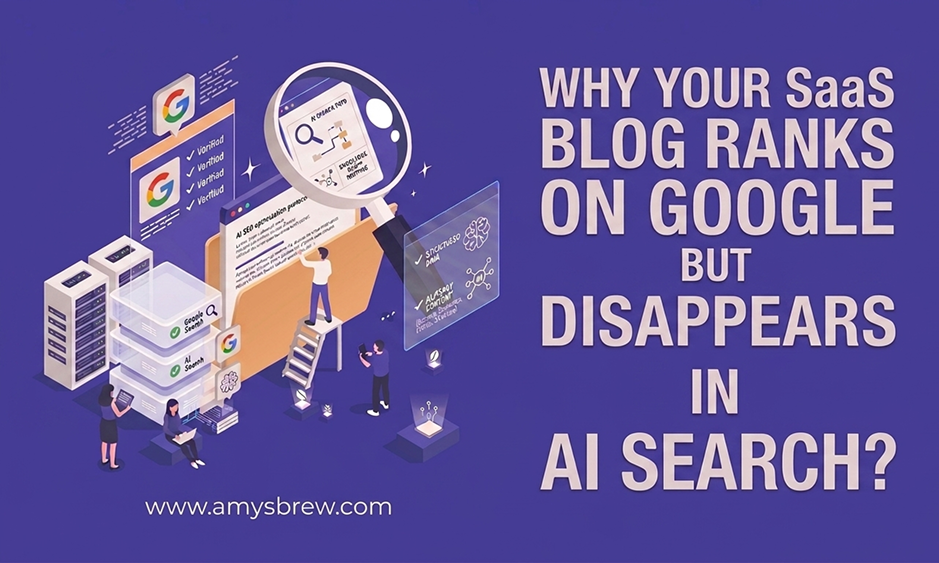
Your content is there, indexed, ranked, sitting on page one. You did the work, ran the keyword research.
But when your buyer opens ChatGPT and types the exact question your best post was written to answer, your brand doesn’t come up.
A competitor with a smaller domain and fewer backlinks gets cited instead.
It’s the content equivalent of a ghost in a library. Present in every catalogue. Referenced nowhere.
That image is also a measurement. EMGI Group studied 150 SaaS companies and found that 44% of brands ranking in Google’s top 10 receive zero ChatGPT citations for the same keywords.
Worth knowing upfront: EMGI is a SaaS link-building and AI-citation agency, so this is vendor-published research, not an independent study.
We’re including it because the underlying method (DataForSEO API, 150 real companies, published methodology) is transparent enough to evaluate, but it’s worth reading with that context.
Nearly half of well-ranked SaaS brands are invisible in the channel now shaping buyer decisions before a single Google result gets clicked.
The gap is already open, and most teams don’t know they’re standing in it.
The reason isn’t bad writing, thin content, or anything Search Console would flag.
It’s something more structural, and understanding it starts with what happened to the relationship between Google rankings and AI citations over the past 18 months.
For the broader context on how SEO, AEO, and GEO sit relative to each other, our GEO vs AEO vs SEO guide covers that ground first.
Quick definition: AI search visibility means whether your brand is cited, summarized, or used as a source by AI-powered discovery systems such as ChatGPT, Perplexity, Claude, and Google AI Overviews.
For SaaS companies, it’s no longer the same thing as ranking on page one of Google.
Key Takeaways
- Ranking on Google and appearing in AI search are now two separate outcomes. EMGI Group’s vendor-published study of 150 SaaS companies found 44% of Google top-10 brands get zero ChatGPT citations for the same keywords.
- The overlap between Google’s top 10 organic results and AI Overview citations has collapsed from 76% in mid-2025 to between 17% and 38% by early 2026, according to Ahrefs and BrightEdge.
- Google asks “what ranks well?” AI asks “what answers this best?” Those are different questions, and they reward different content.
- B2B technology queries trigger AI Overviews on 82% of searches, according to BrightEdge tracking data. Your buyers are seeing AI answers before they ever reach your ranked page.
- The fix isn’t a rewrite. It’s a structural change to how your existing content is formatted, sourced, and organized.
Google Rankings vs AI Search Citations: Why They No Longer Match
For a long time, the relationship between Google rankings and AI visibility felt like a single bet. Rank well, get cited.
ALM Corp reported that as recently as late 2024, roughly 76% of AI Overview citations came from pages ranking in Google’s top 10 for the same query.
The overlap was strong enough that most content teams treated the two as inseparable, build authority on Google, and AI visibility follows.
Then, within roughly 18 months, that assumption collapsed.
Ahrefs analyzed 863,000 keywords and 4 million AI Overview URLs and found the overlap had dropped to 38% by early 2026.
BrightEdge, using different methodology, put it even lower, at 17%. The exact figure matters less than the direction: Google rankings and AI citations are no longer moving in lockstep.
The pace is what commands attention. This wasn’t a gradual drift. It accelerated sharply in January 2026 when Google switched AI Overviews to Gemini 3.
SE Ranking’s post-upgrade analysis reportedly found the new model replaced approximately 42% of previously cited domains in one move.
We weren’t able to locate a direct, linkable version of this specific analysis, so treat that figure as directional rather than fully verified.
Brands that built their AI visibility on the assumption that Google rankings would carry over woke up one morning to find that guarantee had quietly been voided.
To understand why, you have to understand that Google and AI search aren’t doing the same job.
How AI Search Engines Choose What to Cite
Think of Google as a librarian trained on provenance. It asks who wrote this, how long they’ve been writing, who else cites their work.
A page that’s accumulated authority over years will rank, even if a newer, more direct answer exists elsewhere. That’s not a flaw. It’s by design.
AI platforms operate on different logic. Think of them as a researcher under deadline who needs one clean paragraph they can quote verbatim.
They’re asking, at every moment: what can I extract right now that stands on its own?
This is exactly why a page with strong backlinks, a decade of domain authority, and a number-one Google ranking can be passed over entirely by ChatGPT.
The backlinks are invisible to an extraction system.
What gets cited is the page where the answer appears in the first sentence, and the source is named inside the prose.
A single paragraph can be lifted out and used without the three paragraphs around it for context.
Why SaaS Content Doesn’t Get Cited by AI: 4 Structural Reasons
When we audit SaaS blog content that ranks well but earns zero AI citations, the same four structural problems appear every time.
None of them are about the quality of the thinking. They’re about where the thinking lives on the page, and whether the extraction system can find it.
1. The Direct Answer Is Buried Too Deep in the Page
Most SaaS blog posts are structured like a case being built in court. Background first, context second, conclusion near the end.
For a human reader, that works. For an AI extraction system scanning for the most citable passage, there’s nothing clean to pull until paragraph five.
OutpaceSEO reported, citing Growth Memo’s analysis, that 44.2% of all AI citations come from the first 30% of a page’s content.
A post that builds to its answer has already surrendered the majority of its citation opportunity before the reader gets past the introduction.
2. Statistics Lack Named, Linkable Sources
“Research suggests.” “Studies show.” “Industry experts agree.” These phrases carry the shape of evidence without the substance.
AI platforms are trained to prefer verifiable claims over confident-sounding ones, so content full of vague attribution gets treated as noise.
The contrast is stark. “Studies show that content length affects rankings” is invisible to an extraction system.
Orbit Media found that bloggers publishing posts over 2,000 words are nearly twice as likely to report strong results, and that version is citable.
The named source is what an extraction system can locate and verify.
3. No FAQ Schema for AI to Extract
A buyer doesn’t open ChatGPT and type “SaaS content strategy overview.” They type the specific, conversational question they actually have.
A FAQ section is the part of the post most reliably structured in the question-and-answer format AI platforms prefer for extraction.
BrightEdge has reported, via this secondary summary, that sites implementing FAQ blocks saw a 44% increase in AI search citations.
Most SaaS blogs still treat the FAQ as the last thing added before publishing, rather than the citation engine it actually is.
4. AI Crawlers Like GPTBot Are Blocked in robots.txt
This is the quietest, most catastrophic version of the problem, where the content is genuinely good and none of it matters because a single line in a configuration file closed the door.
Pixelmojo has argued that blocked crawlers are one of the most common reasons brands receive zero AI citations, not poor content, a technical oversight.
Check this before anything else: go to yourwebsite.com/robots.txt and look for Disallow entries mentioning GPTBot, ClaudeBot, PerplexityBot, or Google-Extended.
If any appear there, that AI platform has never read a single word of your content, regardless of how well it ranks. This is a five-minute fix that should happen before any content restructuring.
Why B2B SaaS Needs AI Search Visibility More Than Other Industries
Not every industry faces this with the same urgency.
A local restaurant missing from AI citations loses very little, their buyers search with transactional intent, and AI Overviews are deliberately rare for commercial queries.
B2B SaaS is close to the opposite case. BrightEdge tracking, as cited by White Hat SEO, found that B2B technology queries trigger Google AI Overviews on 82% of searches.
B2B buyers at the research stage ask informational questions, and informational questions are exactly what AI Overviews are designed to answer.
If your content isn’t cited in that answer, you don’t exist in that moment. The buyer reads the AI response, clicks one of the cited sources, and forms their first impression of the landscape.
Your page-one ranking sits below the fold, unseen, like a billboard on a road that’s been rerouted.
How to Optimize SaaS Content for AI Search Citations
Improving AI search visibility doesn’t mean rebuilding content from scratch. The research and expertise already sitting in your top posts is almost certainly sufficient.
What’s insufficient is the architecture around it, where the answer lives, whether the source is named in the sentence, whether a crawler can find its way through the door.
Lead every section with the direct answer
State the conclusion in the first sentence, then explain and support it. An extraction system reads the top of a section first and stops when it has what it needs.
Name the source inside the sentence
Not in a footnote. “Ahrefs found that…” needs to sit in the prose itself, because AI systems extract text, and the source name has to be there for the claim to register as verifiable.
Add a FAQ section to every post
Five to seven questions your buyers actually type into AI platforms, answered in two to four direct sentences each, with FAQPage schema applied.
Put comparison data in tables
AI systems extract HTML tables far more reliably than the same information written as prose. If you’re comparing tools or features, the table is a citation choice, not a formatting one.
Update your top posts every 60 days
Perplexity performs a real-time web search on every query. Freshness is a direct citation signal, regardless of where a post sits in Google’s index.
This post focuses on why the gap exists. If you’re building a content strategy from scratch rather than fixing existing posts, our guide to getting cited by AI is the right starting point.
Fixing the SaaS AI Search Visibility Gap
The content that’s invisible in AI search isn’t bad content. It’s content written for a different era of search, one where ranking on Google and being found by buyers were effectively the same thing.
That era ended quietly, somewhere between mid-2025 and early 2026, when the overlap between Google’s top 10 and AI citations dropped from 76% to somewhere between 17% and 38%.
For B2B SaaS, where 82% of queries now trigger AI Overviews, the content sitting unseen below the fold isn’t a small inefficiency.
It’s the majority of your buyer’s research journey happening without you in it.
What to do next
- Audit your top 15 to 20 SaaS blog posts by organic traffic and conversions
- Check whether each section begins with a direct, self-contained answer
- Replace vague phrases such as “studies show” with named, linked sources
- Add five to seven buyer-style FAQ questions with concise answers and FAQPage schema
- Convert comparisons, pros and cons, and statistics into HTML tables
- Review robots.txt to confirm GPTBot, ClaudeBot, PerplexityBot, and Google crawlers aren’t unintentionally blocked
Frequently Asked Questions
Why does my SaaS blog rank on Google but not appear in ChatGPT?
Google and ChatGPT select content using different criteria. Google rewards accumulated authority, backlinks, domain history, keyword relevance.
ChatGPT selects content it can extract a clear, verifiable, direct answer from. A page can have strong Google signals and still be unextractable if its answers are buried or its sources are unnamed.
Is the gap between Google rankings and AI citations getting worse?
Yes, and the pace appears to be accelerating. Earlier data showed stronger overlap between Google’s top results and AI citations, but newer studies suggest that overlap has dropped significantly.
Do I need to rewrite all my existing SaaS blog posts for AI search?
No. In most cases, your existing research and arguments are still useful. What usually needs to change is the structure.
Start with your top 15 to 20 posts by traffic, and check whether each section leads with a direct answer.
Why are B2B SaaS companies more affected by AI search than other industries?
B2B SaaS queries are often informational, questions like “how to reduce churn” or “best CRM for SaaS startups.”
These are exactly the kinds of queries AI Overviews are designed to answer, which makes AI visibility especially important for SaaS companies with top-of-funnel content.
How do I check if AI crawlers can access my SaaS website?
Go to yourwebsite.com/robots.txt and look for Disallow rules mentioning GPTBot, ClaudeBot, PerplexityBot, or Google-Extended.
If any of these are blocked, the corresponding AI platform may not be able to crawl or use your content.
Want content structured to earn both the ranking and the citation?
We help SaaS companies restructure existing content so it’s extractable by AI systems, not just rankable on Google.