B2B Content Marketing: How to Build a Strategy That Actually Works

Quick answer: B2B content marketing is creating and distributing content to attract, educate, and convert other businesses.
Most guides stop at explaining what it is. This one shows you how to build a strategy that actually works, and keep it working as AI search changes how buyers find you.
Key Takeaways
- B2B content marketing is the practice of creating and distributing content to attract, educate, and convert other businesses, not individual consumers.
- 97% of B2B marketers have a documented strategy, but only 12% call it highly effective. The document isn’t the problem.
- Among marketers who improved this year, 74% credit strategy refinement. AI use sits at 95%, but only 39% say it’s improving performance, so speed isn’t the fix either.
- Traditional SEO and AI search reward different things, rankings versus citations, and most strategies still only plan for one of them.
- Buyers are choosing fewer live conversations with sales reps, which puts more weight on your content to make the case a person used to make live.
What is B2B content marketing?
B2B content marketing is the practice of creating and distributing content to attract, educate, and convert other businesses, rather than individual consumers.
It supports longer, multi-stakeholder buying decisions through formats like blog posts, guides, case studies, and comparison pages.
How is it different from B2C content marketing?
B2C content usually targets one person making a faster, more emotional purchase. B2B content supports a slower, group decision with more scrutiny at every step.
A B2B buyer is rarely deciding alone, which shapes almost everything about how this content needs to work.
B2B content marketing vs SEO vs content strategy
These three get used interchangeably, and that causes real confusion. Each one is doing a different job.
| Term | What it actually is |
|---|---|
| Content strategy | The plan: who you’re writing for, what you’re proving, and why it matters to the business |
| Content marketing | Executing that plan, creating and distributing content to achieve marketing goals |
| SEO | One distribution channel that helps content get found in organic search |
A strategy without content marketing behind it never reaches anyone. Content marketing without a strategy is just publishing on a schedule and hoping something works.
Why B2B content marketing matters
HubSpot’s 2026 State of Marketing research found website, blog, and SEO content remains the top ROI-generating channel B2B marketers report, ahead of paid social.
That’s not surprising once you consider how B2B buyers actually behave before they ever talk to your team.
Gartner’s 2026 survey found 67% of B2B buyers now prefer to avoid a salesperson entirely during the buying process.
If your buyer is actively trying to avoid your sales team, your content is doing the job a person used to do. That’s the actual case for taking this seriously.
Types of B2B content, organized by the job each one does
A format list doesn’t tell you much on its own. What matters is which job in the buyer’s decision each piece is meant to do.
Discovery content
Blog posts, guides, and original research. Built to bring in a reader who doesn’t know your brand yet and is searching for an answer.
Evaluation content
Comparison pages, alternative pages, and product guides. Built for a buyer who knows the category and is narrowing down options.
Proof content
Case studies, customer stories, and benchmarks. A buyer comparing options wants to see the outcome happen for someone else first.
Sales enablement content
One-pagers, objection guides, and internal buying guides. Built to be forwarded, so your champion can bring the rest of the committee along.
Authority content
Original research, industry reports, and expert commentary. This is where thought leadership lives, built to earn citations and trust rather than an immediate click.
Whatever you call the discipline behind this, demand generation, content marketing, or just “the blog,” the underlying job is the same: match content to real buyer intent, not assumed intent.
B2B content marketing channels
Creating content is half the job. Where it actually reaches a buyer is the other half, and it’s worth being deliberate about both.
| Channel | Best for |
|---|---|
| Organic search | Capturing demand from buyers already searching for an answer |
| Professional reach and distributing content to your existing network | |
| Nurturing an audience that already knows you | |
| Sales enablement | Helping your champion argue your case internally |
| Industry publications | Borrowing authority you haven’t built yet on your own domain |
| Communities and forums | Building trust through real conversation, not a pitch |
| AI search and answer engines | Being the source an AI system cites during a buyer’s research |
Most programs lean almost entirely on one or two of these and wonder why reach stays flat.
Owned channels, like your blog, earned channels, like a citation in the press, and paid channels each do different work, and a healthy program uses more than one.
Using digital PR to extend your reach
A citation from a credible publication can increase referral traffic, visibility, and brand recognition.
It may also support the broader authority signals tied to discoverability.
That’s different from claiming it directly tells an AI system your site is trustworthy, which isn’t something we can state as established fact.
The practical version of this is simple: pitch your original research and data, not your product, to journalists and industry writers. Data is what gets cited. Product pitches get ignored.
How to build a B2B content strategy that actually works
Skip the generic version of this advice. Here’s the actual sequence worth following, and where most teams quietly skip a step.
Define the business goal
Pipeline, product adoption, brand awareness, or category creation are different goals that require different content.
Define the buying audience specifically
Not just “B2B decision-makers.” Name the economic buyer, the champion, and the technical evaluator separately, since each reads differently.
Identify what they’re actually searching for
Real buyer problems, not assumed ones. This is where most strategies guess instead of check.
Map content to intent, using the funnel as your structure
Informational, commercial investigation, comparison, and decision-stage content all need to exist, in that rough order. TOFU, MOFU, and BOFU give this structure a name.
| Stage | Buyer intent | Best formats | Goal |
|---|---|---|---|
| TOFU | Learning about a problem | Blog posts, guides, original research | Attention and trust |
| MOFU | Comparing solutions | Comparison pages, webinars, whitepapers | Consideration |
| BOFU | Ready to decide | Case studies, demos, ROI calculators | Conversion |
This isn’t a separate exercise from your strategy. It’s what “map content to intent” actually means in practice: every piece in your architecture should sit clearly in one of these three stages.
Give every page a job
Not a topic. A job. What is this specific page supposed to accomplish for the reader and for you?
Build the content architecture
Connect pillar content, supporting articles, and commercial pages to each other before you worry about promotion.
Distribute deliberately
Search, social, email, sales, and third-party channels each reach a different part of the buying group. Pick more than one on purpose.
Measure against the business outcome
Traffic and leads are visible. Pipeline and revenue influenced are what the strategy was actually built to move.
What are the most common B2B content marketing challenges?
CMI’s 2026 research found the top three reported challenges are creating content that drives a real action, at 40%, resource constraints, at 39%, and measuring content effectiveness, at 33%.
Look closely and these three aren’t separate problems. They’re the same one, seen from three different desks.
You can’t measure whether a page worked if you never wrote down what it was supposed to prove. You can’t easily prioritize resources without knowing which claims matter most to defend.
And content struggles to drive action when it never states a specific claim worth acting on in the first place.
The real gap: strategy is common, effectiveness isn’t
Here’s where most B2B content marketing quietly breaks down, and it’s worth understanding clearly before you build anything.
CMI’s 2026 research found 97% of B2B marketers have a documented strategy. Only 12% call their program highly effective.
Your first guess might be that most strategies are just badly written. Follow the data one step further and a different answer shows up.
Among marketers who improved this year, 74% credit refining their existing strategy. Only 51% credit new technology.
People are actively reworking these documents. Neglect isn’t the explanation.
So try a second guess: maybe the tools needed to execute a strategy well just haven’t caught up yet.
That doesn’t hold up either. The same CMI survey found 95% of B2B marketers already use AI. Only around 39% say it’s improving their content’s performance.
Here’s why. Producing content used to be slow, and that slowness quietly filtered out weak ideas before they were ever published.
AI removed that friction. A weak idea can now become a finished page in minutes, with nothing left to stop it.
So the filter disappeared, not the vagueness. What used to get dropped now gets published on schedule instead.
That’s the real reason 95% adoption produced 39% improvement, and it means the fix was never about speed.
Why this matters more as buyers change
For years, a weak content strategy barely mattered, because a salesperson in the room could patch the gap live, tailored to whatever the buyer was unsure about.
That safety net is disappearing, and buyers are the ones removing it.
You already saw that 67% of B2B buyers now prefer a rep-free experience. At the same time, a B2B purchase is rarely one person’s decision.
Edelman and LinkedIn’s 2025 research found more than 40% of B2B deals stall because people inside the buying group can’t agree among themselves.
Line those two facts up. Buyers want fewer conversations with a seller, but the group still has to agree without one.
Your content is what’s left in the room once that salesperson is gone.
One more piece worth knowing. The same Gartner research found 69% of buyers still go to a human to double-check what an AI tool told them.
Buyers are avoiding salespeople and still relying on them, just for a narrower job: confirming something specific is true. Vague content gives them nothing to confirm.
The Claim, Evidence, Action framework
Most strategy documents list an audience, some topics, and a publishing calendar. That’s a production plan, and it’s necessary, but it’s not enough.
Here’s the simple check we use instead, on every important page.
Before you publish, answer three questions
Claim
What is this page actually saying? Not the topic, the specific position.
Evidence
Why should the buyer believe it? Name the source, the data, or the example.
Action
What should the reader do with this, once they believe the claim?
If a page can’t answer all three, it’s not finished, no matter how polished the writing is.
Thought leadership vs content marketing
These get used interchangeably, but they’re not the same thing. Content marketing is the discipline.
Thought leadership is a specific type of content within it, built on a genuine point of view, not just information.
Edelman and LinkedIn’s 2025 research found 95% of hidden buyers say strong thought leadership makes them more receptive to being contacted at all.
Hidden buyers are the internal stakeholders who influence a deal without being the named decision-maker.
The same research found 79% say they’re more likely to advocate for a vendor internally during a formal evaluation if that vendor consistently publishes high-quality thought leadership.
The catch: most thought leadership fails at the one thing that makes it work. It repeats what’s already been said instead of adding a genuine, defensible point of view.
The Claim, Evidence, Action check above applies here more than anywhere else. If a competitor could have written your thought leadership piece, it isn’t actually thought leadership.
B2B content marketing in the age of AI search
Traditional SEO and AI search reward different things, and most B2B strategies still only plan for one of them.
| Traditional SEO | AI search |
|---|---|
| Rankings | Citations |
| Clicks | Mentions inside an answer |
| Keywords | Entity and brand recognition |
| Backlinks | Source selection by the AI system |
| Meta descriptions | Extractable, self-contained answers |
The two aren’t separate strategies. They’re the same content, evaluated by two different kinds of readers, one human clicking a blue link, one system deciding what to quote.
What increases the odds of being the source an AI system cites: original research it can’t get anywhere else, clearly named authorship.
Also: direct answers stated plainly, and technically accessible content the system can actually parse.
Be skeptical of specific “AI SEO hacks.” Established practice here is still thin.
What’s defensible: original, first-party evidence and clear, direct answers tend to get selected more often. What’s not proven: that any single technical trick reliably increases citation rates.
We go deeper on this distinction in our AI SEO.
Five B2B content marketing examples worth studying
HubSpot
What they’re doing: A free education hub and certification academy teaching inbound marketing, not just HubSpot’s product.
Why it works: Learning content builds a relationship before a sale is discussed, so by the time someone’s ready to buy, HubSpot is already the trusted source.
What you can replicate: You don’t need a full academy. A single, genuinely useful how-to series in your category does the same job at a smaller scale.
Gong
What they’re doing: Original research pulled from their own product data on real sales conversations.
Why it works: The claim is impossible to copy without the same underlying dataset, the strongest kind of authority content marketing can produce.
What you can replicate: Look at your own product or service data. Even a small, honest data point nobody else has outperforms generic advice.
Ahrefs
What they’re doing: Teaching SEO using their own tool inside the tutorial itself.
Why it works: The content and the product demo are the same asset, so there’s no gap between learning and trying the product.
What you can replicate: Build tutorials around your actual product interface, not a generic version of the task.
Salesforce
What they’re doing: Resources organized explicitly by funnel stage, not by topic alone.
Why it works: A reader can self-identify where they are and immediately find the next relevant piece, reducing the research burden on the buyer.
What you can replicate: Label your own resource hub by stage, getting started, comparing options, ready to buy, not just by category.
What they’re doing: The B2B Institute publishes original research on marketing effectiveness, positioning LinkedIn as a research source, not an ad platform.
Why it works: It reframes the brand’s relationship with its audience from seller to credible source, a harder position for competitors to attack.
What you can replicate: Publish one real finding from your own data annually, even a small one, consistently, rather than a one-off report.
The B2B content marketing system
This guide is the hub. Each piece below is one working part of the same system.
Strategy
The 8-step sequence above
Funnel
TOFU, MOFU, BOFU mapping, above
SEO & AI search
SaaS content
Thought leadership
Covered above
Measurement
ROI formula below
Examples
Five above
Real results
B2B content marketing for SaaS specifically
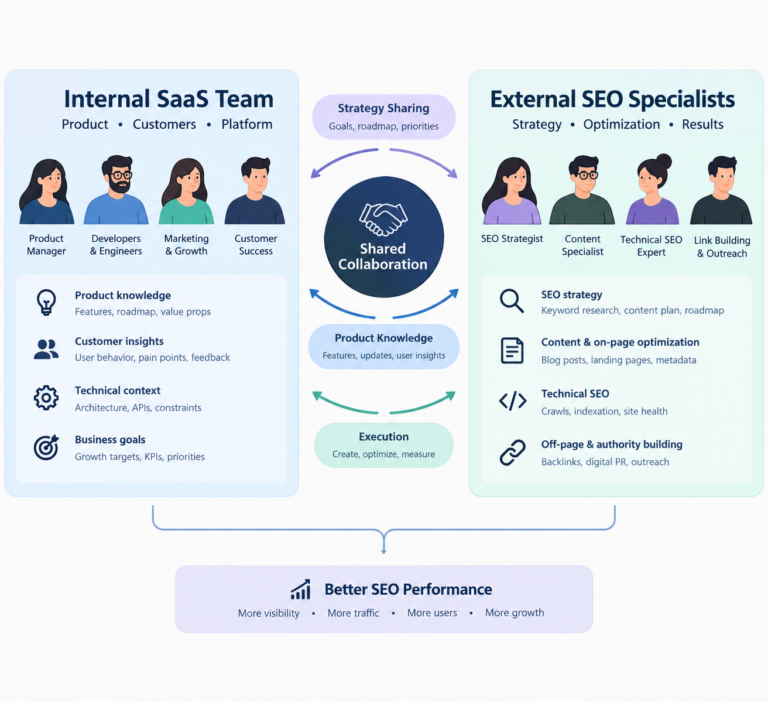
SaaS buyers add one more layer most B2B advice doesn’t cover. They research through AI tools like ChatGPT and Perplexity as much as Google, often in the same session.
We cover what that changes in our GEO vs AEO vs SEO.
How to measure B2B content marketing
Vanity metrics live near the top of the funnel. Business impact lives at the bottom. A healthy measurement plan tracks both, without confusing one for the other.
| Stage | What to track |
|---|---|
| Awareness | Organic impressions, branded search volume, reach |
| Engagement | Engaged sessions, content depth, returning visitors |
| Conversion | Leads, demo requests, content-assisted conversions |
| Revenue | Pipeline influenced, revenue influenced, customer acquisition cost |
A simple ROI formula
Content ROI is usually calculated as: value generated minus cost of content, divided by cost of content, expressed as a percentage.
The honest limitation: “value generated” rarely has a clean line back to one piece of content, since B2B deals involve many touchpoints.
Track content-assisted conversions and pipeline influence as your best available proxy, not a perfect number.
Don’t judge a content program by the metric closest to the publishing team. Judge it by the business outcome it was actually designed to influence, since that’s what content ROI actually measures.
Our B2B SaaS keywords walks through the demand side of this same funnel.
Common B2B content marketing mistakes
Publishing without a stated claim
A topic isn’t a claim. If a page can’t say what it’s proving, it’s unlikely to change anyone’s mind.
Measuring only what’s easy to measure
Traffic is visible. Pipeline influence takes more work to track, and that’s exactly why it gets skipped.
Treating every channel the same
A LinkedIn post, an email, and a pillar page all do different jobs. Writing them identically wastes each one.
Producing thought leadership that just repeats others
If a competitor could have published the same piece, it isn’t building the trust real thought leadership is supposed to build.
Never activating content after publishing it
A piece that only lives on your blog reaches a fraction of the people it could. Sales enablement, email, and social all need their own push.
Ignoring hidden buyers
The named decision-maker isn’t the only person who matters. Internal influencers without a title often decide whether a deal actually closes.
Chasing every channel at once instead of two or three well
Spreading thin across every platform usually produces mediocre results everywhere instead of strong results somewhere.
Never auditing old content
Pages decay. A page that ranked well two years ago can quietly lose relevance, traffic, and accuracy without anyone noticing until it’s audited.
Frequently Asked Questions
What is B2B content marketing?
B2B content marketing is the practice of creating and distributing content, like blog posts, guides, and case studies, to attract and educate other businesses.
The goal is converting them into customers, not individual consumers.
Why is B2B content marketing important?
Buyers increasingly research and shortlist vendors before ever speaking to a salesperson. Content is often the only thing representing your company during that stage.
What’s the difference between B2B and B2C content marketing?
B2C content usually targets one person making a faster, more emotional purchase. B2B content supports a slower, multi-person decision that requires more proof and more patience.
What’s the difference between content marketing, content strategy, and SEO?
Content strategy is the plan. Content marketing is executing that plan to reach and convert an audience. SEO is one distribution channel that helps the content get found.
What types of content work best for B2B?
Discovery content brings in new readers, evaluation content serves buyers comparing options, proof content builds trust, and sales enablement content helps your champion argue your case internally.
How is AI search different from traditional SEO for B2B content?
Traditional SEO optimizes for rankings and clicks. AI search optimizes for being cited or mentioned inside an answer, which rewards original evidence and clear, direct writing over keyword placement.
What are the biggest challenges in B2B content marketing?
CMI’s 2026 research found the top three are creating content that drives action, resource constraints, and measuring effectiveness.
All three trace back to strategies that never state what a piece of content is supposed to prove.
Does B2B content marketing work differently for SaaS companies?
The fundamentals are the same, but SaaS buyers research across both traditional search and AI tools more heavily than most B2B categories.
That adds a real second dimension to how content needs to be structured.
Want content built around a real claim, not just a topic?
We help B2B and SaaS teams find the actual argument their content should be making, and back it with evidence that holds up.