100 B2B SaaS Keywords, Organized by Buyer Journey Stage
Not a volume-sorted list. A full-funnel keyword framework built around how B2B software buyers actually search, from first pain point to renewal.
Key Takeaways
- These 100 keyword patterns are organized by funnel stage: awareness, consideration, decision, retention, and AI-chat queries, not sorted by search volume.
- Search volume and CPC change monthly and vary by tool and region, so this list skips invented numbers. Pull live volume for your niche from Ahrefs, Semrush, or Google Search Console before you commit writing time.
- B2B SaaS deals now take an average of 266 touchpoints to close, up 20% from the year before (HockeyStack Labs, 2024). A keyword strategy that only covers one funnel stage is covering a fraction of that journey.
- Bracketed placeholders like [Category] and [Competitor] are meant to be filled in with your actual product category, named competitors, and target industries.
- The last 10 keywords are written the way buyers now phrase questions to ChatGPT and Perplexity, not the way they type into Google.
Most “keyword list” posts hand you 100 terms sorted by search volume and call it a strategy.
That works if you’re buying ads. It doesn’t work if you’re building content, because a buyer researching a problem for the first time and a buyer comparing two vendors by name are looking for completely different pages. Hand them the same kind of content and you lose both.
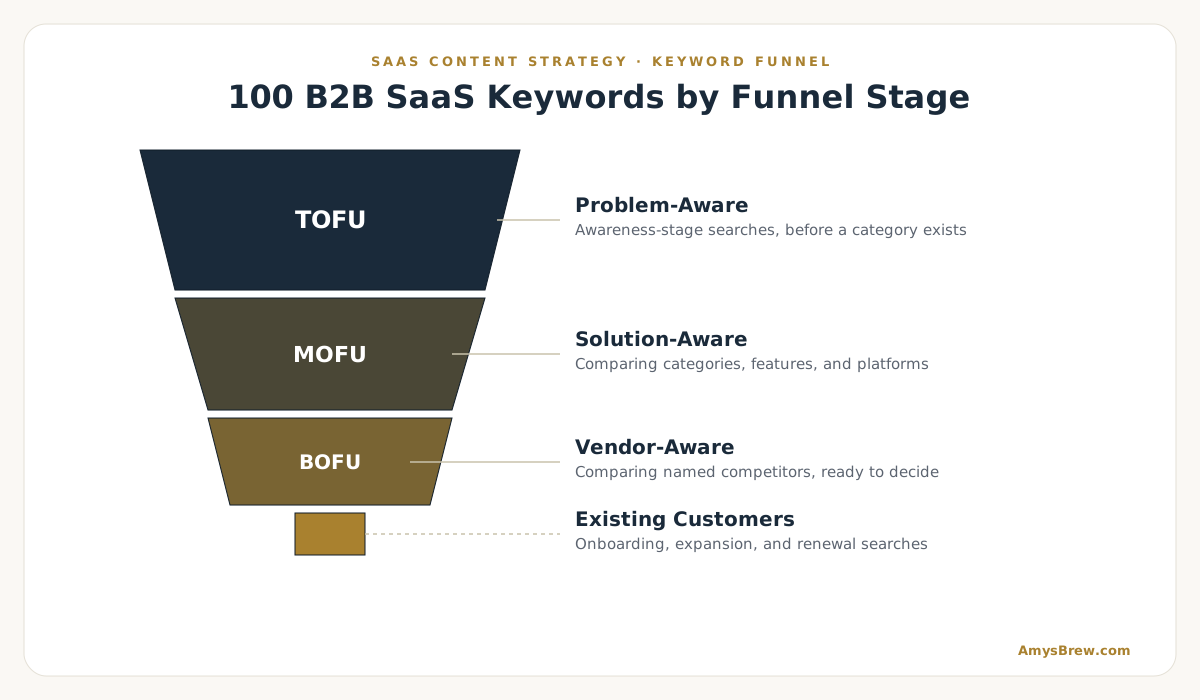
So this list is organized differently. Instead of ranking keywords by volume, it’s organized by where the buyer is in their journey: problem-aware, solution-aware, vendor-aware, existing customer, and increasingly, mid-conversation with an AI chatbot.
Fill in the brackets with your own product category, named competitors, and target industries, and you have a keyword map that mirrors how your buyers actually move.
Why Funnel Stage Matters More Than Volume
A B2B SaaS deal now takes an average of 266 touchpoints to close, a 20% increase from the year before.
That figure comes from HockeyStack Labs’ analysis of 150 B2B SaaS companies ranging from $8 million to $2 billion in ARR. Deals above $100K in annual contract value need nearly 1.5 times that number.
There’s no ideal world, resources are limited, runways are short, and conversion at first visit is nothing more unusual than love at first sight.— HockeyStack Labs
A buyer journey with that many touchpoints isn’t won with one kind of content. It’s won by having something relevant at every stage: the early searches when someone is still describing a problem to themselves, the middle searches when they know a category of tool exists, the late searches when they’re comparing you by name, and the searches that happen after they’ve already bought. This list covers all five.
Top of Funnel: Problem-Aware Keywords
These are searches from people who feel a problem but haven’t started shopping for a solution yet. They rarely mention a product category. Content here should educate first and mention your product last, if at all.
TOFU · Problem-Aware
- why is my
[metric]so high - how to reduce customer churn
- what is customer success software
- how to calculate MRR
- SaaS metrics that actually matter
- how to improve trial-to-paid conversion
- signs you’ve outgrown your current
[category]tool - what is workflow automation
- how to scale support without hiring
- B2B marketing strategy for startups
- how to reduce cart abandonment
- what causes low user activation
- SaaS onboarding best practices
- how to reduce support ticket volume
- what is product-led growth
- how to improve net revenue retention
- SaaS pricing models explained
- what is customer lifetime value
- how to build a B2B content strategy
- SaaS security compliance checklist
- remote team collaboration challenges
- how to automate repetitive tasks at work
- what is a buying committee
- B2B sales cycle length benchmarks
- how AI is changing B2B research
Middle of Funnel: Solution-Aware Keywords
These buyers know a category of tool exists and are learning what to look for. This is where category education, feature comparisons, and buying guides earn trust before a vendor name ever comes up.
MOFU · Solution-Aware
[category]software for startups- workflow automation software for teams
- best
[category]platform for enterprise [category]software for remote teams- cloud vs on-premise
[category]software - features to look for in
[category]software - how to choose a
[category]tool [category]software pricing guide- SaaS security compliance software
- AI-powered
[category]software - no-code automation tools
[category]software for small business- B2B CRM software comparison
- project management software for agencies
- customer data platform vs CDP
[category]software integrations guide- self-serve vs sales-led SaaS
[category]software implementation timeline- how does
[category]software work - SaaS vs on-premise software
- API-first
[category]platform [category]software free trial- white-label
[category]software - multi-tenant
[category]architecture [category]software for[industry]teams
Bottom of Funnel: Vendor-Aware Keywords
These buyers know the category and are comparing specific vendors, often by name. Lower volume, higher intent. This is where comparison pages, alternative pages, and pricing pages do the actual converting.
BOFU · Vendor-Aware
[Competitor A]vs[Competitor B][Competitor]alternatives[Competitor]pricing[Competitor]reviews- best
[category]software 2026 [category]software case study- request a
[category]software demo [category]software free trial signup[category]software for[industry]- is
[Competitor]worth it [Competitor]vs[Your Brand]- cheapest
[category]software - enterprise
[category]vendors [category]software ROI calculator[category]software implementation cost- why switch from
[Competitor] [category]software G2 reviews[category]software on Capterra[category]software on TrustRadius[category]software security certifications[category]software SLA[category]software contract terms[category]software vendor comparison[category]software buyer’s guide[Competitor]vs[Competitor]for[use case]
Retention & Expansion Keywords
SaaS revenue doesn’t stop at the signature. Existing customers search too, and content built for them supports onboarding, reduces churn, and surfaces upsell opportunities. Most content calendars skip this stage entirely.
Retention & Expansion
- how to onboard new users to
[category]software [category]software API documentation[category]software certification[category]software training- how to reduce churn in
[category]software [category]software advanced features[category]software integrations marketplace[category]software upgrade guide[category]software best practices[category]software community[category]software support tiers[category]software renewal checklist[category]software upsell playbook[category]software customer stories[category]software power-user tips
AI-Chat Query Patterns
A growing share of research happens as a conversation with ChatGPT, Gemini, or Perplexity, not a search box.
These queries are longer, more conversational, and more specific about the buyer’s situation.
Answer-first, FAQ-formatted content is what earns citations here. For the data behind this shift, see 51% of B2B Buyers Now Start With AI, Not Google.
AI-Chat Queries
- what’s the best
[category]tool for a[company size]company - which
[category]software has the best[feature] - is
[Competitor]good for[use case] - recommend a
[category]tool for[industry] - compare
[category]tools for[specific need] - what should I look for in
[category]software - is
[category]software worth it for a small team - which
[category]tool integrates with[other tool] - what’s a good alternative to
[Competitor]for[use case] - how do I choose between
[Competitor A]and[Competitor B]
How to Prioritize These 100 Keywords
You won’t write all 100 at once, and you shouldn’t try. Ahrefs, which maintains the keyword database most SaaS marketers already use, scores prioritization on three factors: business potential, traffic potential, and ranking potential.
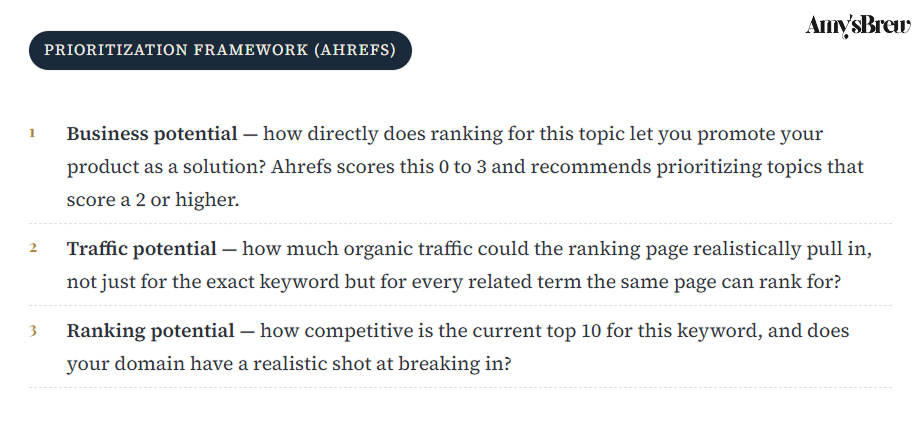
In practice, for a full-funnel SaaS keyword list, business potential tracks closely with funnel stage: BOFU keywords score highest because they let you talk directly about your product, TOFU keywords score lowest because the searcher isn’t shopping yet.
Ahrefs’ own keyword research guide puts it plainly: prioritize topics scoring 2 or 3 on business potential first, since those are the ones most likely to bring paying customers rather than just readers.
The same logic is laid out in Ahrefs’ guide to building a keyword strategy, which frames it as finding keywords with traffic, business, and ranking potential all at once, not just the highest volume.
Intent also has a name in SEO, and it’s worth knowing before you prioritize.
Ahrefs defines four core intent types: informational (your TOFU list), commercial (your MOFU list), transactional (your BOFU list), and navigational (branded searches for your own product, once you have one).
Matching content format to intent, a blog post for informational, a comparison page for commercial, a pricing or demo page for transactional, matters as much as the keyword itself.
Frequently Asked Questions
What are the best SaaS keywords to target first?
Start with BOFU: comparison pages, alternative pages, and pricing pages. They get less traffic than TOFU content, but they convert at a much higher rate because the searcher already knows the category and is close to a decision. Build TOFU content once your decision-stage pages are solid, not before.
How do I fill in the bracketed placeholders?
[Category] is your product type (CRM, HR software, e-signature). [Competitor] is a named vendor you’re actually compared against. [Industry] is a vertical you sell into (healthcare, fintech, logistics). [Use Case] is a specific job the software does. Run each filled-in phrase through a keyword tool before you commit to writing it.
Why doesn’t this list include search volume or CPC?
Search volume and CPC are pulled from proprietary databases like Ahrefs, Semrush, and Google Ads, and they shift monthly by region and by tool. Publishing invented numbers next to real keyword phrases would misrepresent them as verified data. Pull current numbers for your specific niche before prioritizing.
Do I need content for the retention stage if I’m focused on new customer acquisition?
Eventually, yes. In SaaS, expansion and renewal revenue come from existing customers finding what they need without opening a support ticket. Retention content also tends to be far cheaper to produce than acquisition content, since you already understand the product deeply.
How is the AI-chat category different from a normal keyword?
Traditional keywords are short and fragment-like (“CRM software SMB”). AI-chat queries are full sentences with context (“what CRM should a 40-person B2B company use if pricing transparency matters”). Content written to answer the full question, not just the keyword fragment, performs better in both formats.
References
- Ahrefs. (n.d.). Keyword research: The beginner’s guide. https://ahrefs.com/seo/keyword-research
- Ahrefs. (2026). Search intent in SEO: What it is & how to optimize for it. https://ahrefs.com/blog/search-intent/
- Ahrefs. (n.d.). How to build a keyword strategy. https://ahrefs.com/blog/keyword-strategy
- HockeyStack Labs. (2024). B2B customer journey touchpoints: The impact of deal and company size. https://www.hockeystack.com/lab-blog-posts/b2b-customer-journey-touchpoints
Turn this list into a content calendar
A keyword list is a starting point, not a strategy. If you want these mapped to a real content calendar with priority and search intent attached, let’s talk.