
A SaaS SEO audit can leave you with a spreadsheet full of warnings and no clear next step. The way out is not to fix every item in the order a tool lists it. Prioritise findings by the pages they affect, the evidence behind them, the likely impact on customers and the business, the effort involved, and the dependencies required to fix them.
A useful SEO audit action plan turns findings into decisions: what to do now, what to investigate, what to defer, and what to monitor. For a SaaS team, it should also distinguish a problem on a revenue-critical product page from a low-impact issue on an old article.
If you need the issue-discovery checklist first, use Amy’s Brew’s existing SaaS SEO audit checklist. This article covers the next step: deciding what to do with the findings.
Why is it hard to prioritise SEO audit issues?
Audit tools report issues, not business context. A crawler may identify broken links, duplicate titles, slow templates and pages without internal links. It cannot know which product line leadership has prioritised, whether a page drives qualified demos, how long an engineering fix will take, or whether two URLs serve different customer needs.
That is why a list of “critical” errors should be treated as a prompt to investigate, not a finished roadmap. The severity label from a tool reflects its own rules. Your team still needs to assess affected pages, user impact, evidence and implementation cost.
Step 1: Group findings by the decision they affect
Start by putting each finding into a practical workstream:
- Access and indexation: can crawlers reach and index the pages that should appear?
- Site structure and internal links: can readers and search engines discover priority pages?
- Page usefulness and intent: does the page answer the question implied by the search?
- Commercial journey: does the page help a buyer take a sensible next step?
- Measurement: can the team tell whether a change made a difference?
- Maintenance and risk: are there outdated claims, broken resources or avoidable duplication?
Grouping helps reveal patterns. If 40 product pages share the same title issue, the work may belong to a template fix, not 40 individual tickets. If several “orphaned” pages are intentionally archived resources, the answer may be to remove them rather than build links.
Step 2: Record the page and the audience
For every issue, list the affected URL or template, the intended audience, the page’s job, and the next action a reader should be able to take. Add business context: product line, market, funnel stage, and whether sales or customer success rely on the page.
A missing internal link on a priority product page may matter more than the same issue on a retired campaign page. A conversion problem on an early educational article may call for a useful related guide rather than a “Book a demo” button.
Step 3: Check evidence before estimating impact
Separate observed evidence from assumptions. Evidence may include:
- Search Console impressions or clicks for the page or query group.
- Analytics engagement or conversion events, where configured.
- CRM or sales notes showing the page’s role in buyer research.
- Crawl data showing indexability, status codes, canonical conflicts or internal-link depth.
- Customer-support questions that reveal missing explanations.
- Repeated template issues confirmed across representative URLs.
Record the date range, geography and data source. Low traffic does not prove a page has no value; a new page may not have had time to surface, and a low-volume page can serve a valuable buyer. Conversely, a high-traffic page may attract an audience that does not fit the product.
Step 4: Score priority with a simple model
Use a lightweight 1–5 score for each dimension:
- Business relevance: how closely does this affect a priority product, audience or commercial goal?
- User/search impact: how much friction, confusion or loss of access could it cause?
- Evidence confidence: how sure are you that the issue exists and that the proposed fix addresses it?
- Reach: how many important pages or users are affected?
- Effort: how much work, coordination and review is required? Score high effort as a cost.
A simple prioritisation score can be:
Priority = (Business relevance × User/search impact × Evidence confidence × Reach) ÷ Effort
Treat the score as a conversation aid, not scientific precision. Use low/medium/high if numeric scores create false certainty. Record dependencies separately: developer time, product approval, legal review, analytics access, or an external provider.
Step 5: Separate fixes, investigations and experiments
Not every audit finding should become a fix ticket.
- Fix: evidence is strong and the solution is clear. Example: a priority page has a confirmed accidental noindex directive.
- Investigate: evidence suggests a problem, but the cause or best response is unclear. Example: two similar pages may or may not serve distinct intents.
- Experiment: several options are plausible and the result can be measured. Example: test a more useful next step on a relevant guide.
- Defer or close: low value, obsolete, already resolved, or dependent on a larger redesign.
This prevents teams from treating uncertain recommendations as facts.
Step 6: Build a 90-day roadmap
A workable roadmap usually has three horizons:
First 30 days — remove blockers and establish the baseline. Confirm tracking, fix high-confidence access/indexation problems, agree page groups and owners, and document current query/page performance. Avoid making many simultaneous changes that cannot be evaluated.
Days 31–60 — improve priority pages and templates. Address repeated template issues, improve pages tied to priority buyer questions, add useful internal links, and resolve confirmed overlap. Coordinate with product experts and engineering.
Days 61–90 — publish or test the next layer. Build supporting content for validated gaps, add proof or examples, test appropriate next steps, and review early signals. Search outcomes may take longer than 90 days; use this checkpoint to learn and decide, not to promise a ranking result.
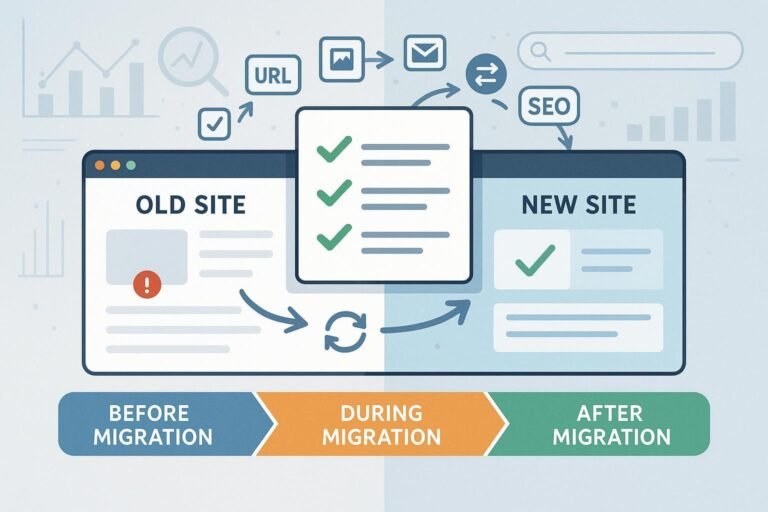
Adjust this sequence to the sales cycle, development capacity and severity of real access problems. A site migration or indexing failure changes the order.
Example: turning findings into a decision
Consider a fictional SaaS company with three findings:
- Several priority product pages are excluded from indexing due to a template directive.
- A long-tail blog post has an outdated statistic.
- A guide about a broad industry term has no conversion CTA.
The first finding has high potential impact and strong technical evidence; it is likely an urgent investigation/fix with engineering ownership. The stale statistic needs editorial verification and a substantive update. The CTA issue should be judged by intent: a helpful next-step link may suit the guide better than a direct sales button. The team should record the rationale and baseline for each action.
Replace this fictional example with an anonymised Amy’s Brew project only if the client has approved its use and the details can be verified.
What should an SEO action plan contain?
Use a shared tracker with these columns:
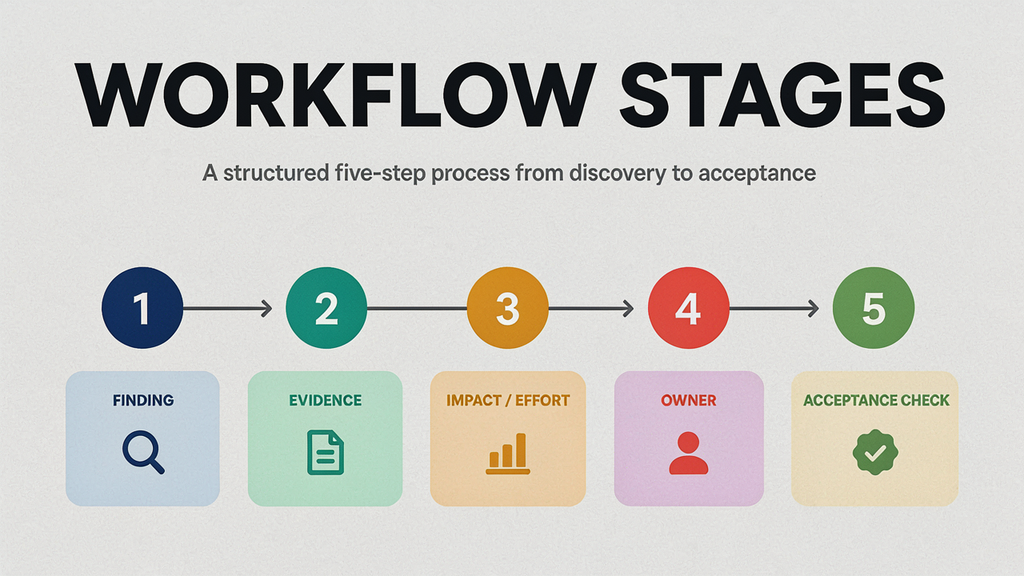
| Field | What to record |
|---|---|
| Finding | Plain-language description |
| Affected page/template | URL, URL group or component |
| Intended audience/job | Who the page serves |
| Evidence | Source, date range and observation |
| Proposed action | Fix, investigate, experiment or defer |
| Priority | Score or agreed tier |
| Owner/dependency | Person/team, approvals and access |
| Effort | Estimate and confidence |
| Acceptance criteria | How the team knows the work is complete |
| Review measure/date | What to inspect and when |
Close every finding with a decision. “Investigate and return with evidence” is a legitimate outcome; an unowned spreadsheet row is not.
When should you ask for outside help?
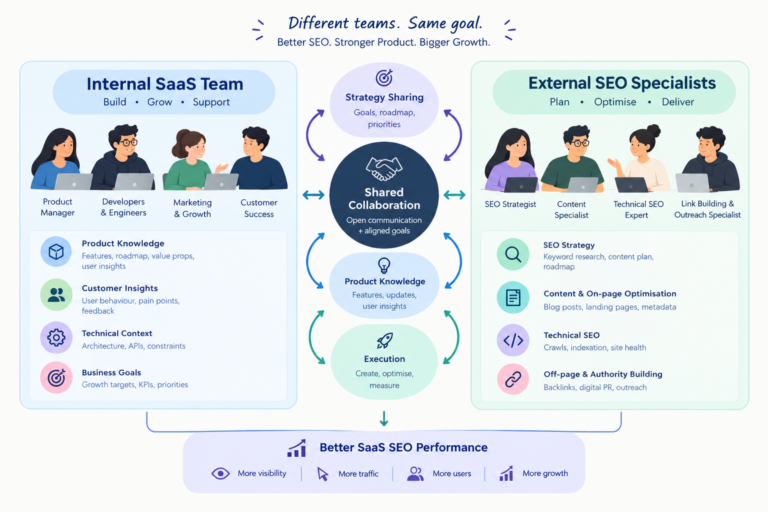
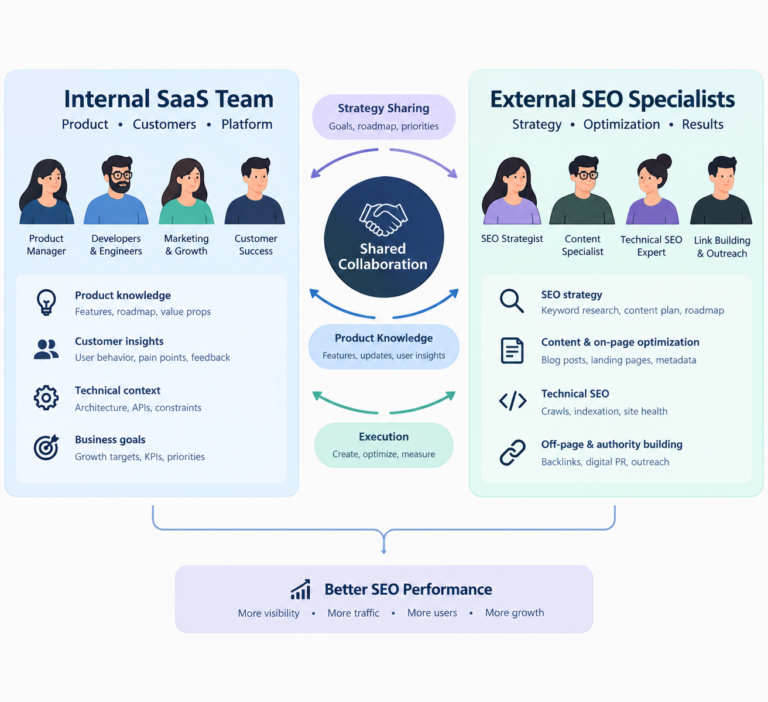
Bring in a specialist when the findings require technical diagnosis the team cannot confidently perform, when the backlog crosses SEO, content and engineering, or when leadership needs an independent prioritisation view. Before choosing a provider, compare in-house SEO, an agency and a consultant, then use the SaaS SEO proposal checklist to assess scope and measurement.
A good audit creates clarity. The value comes from acting on the right findings, assigning ownership and checking whether the work improved access or the buyer journey. You do not need to clear every warning to make progress; you do need a reason for the order.
Frequently asked questions
What should I fix first after an SEO audit?
Start with confirmed issues that block access to important pages or affect a priority buyer journey. Check the evidence, affected pages, effort and dependencies before assigning the work.
How do I prioritise technical SEO issues?
Consider business relevance, user impact, evidence, how many important pages are affected, and the effort to fix the issue. Treat any score as a planning aid, then confirm technical changes with the site or engineering team.
How often should a SaaS website be audited?
Review important technical and content signals regularly, and run a broader audit when the site changes significantly, such as during a migration, redesign or major product expansion. Set the cadence based on how often the site changes and what your monitoring shows.
Should I fix every issue in an SEO audit?
No. Some findings may be low-impact, irrelevant, already resolved or based on a tool’s generic rules. Record a reasoned decision for each item: fix, investigate, test, defer or close
CTA: Have an audit but no clear order of work? Amy’s Brew can help turn the findings into a prioritised SEO roadmap. Get in touch to discuss your SEO priorities.