51% of B2B Buyers Now Start With AI More Often Than Google

What the latest B2B software buyer data means for AI search, Google SEO, and SaaS content strategy.
Key Takeaways
- 51% of B2B software buyers now start research with an AI chatbot more often than Google. That’s up from 29% in April 2025 (G2, 2026).
- Only 12% of URLs cited by ChatGPT, Gemini, and Copilot also rank in Google’s top 10 for the same prompt (Ahrefs, 2025). Ranking well and getting cited are not the same thing.
- Generative AI chatbots are now the top influence on B2B software shortlists. Ahead of review sites, market research firms, and vendor websites (G2, 2026).
- When an AI answer raises questions, buyers check review sites first. That’s the most confidence-inspiring signal (G2, 2026).
- Winning AI visibility needs a different content structure than winning a Google ranking, not simply more of the same SEO work.
A SaaS founder opens Search Console on a Tuesday morning. The blog ranks #1 for its target keyword. The pipeline is still dry.
That’s not a tracking glitch. Half of a buyer’s research now happens somewhere Search Console can’t see. It happens inside a chat window, before Google ever comes into play.
“Rank #1” used to be the finish line. Now it’s barely the start. B2B software buyers are skipping the search results page. They’re asking ChatGPT, Gemini, or Claude to build the shortlist instead. Content built for a results page was only built for half the race.
Here’s the data behind that shift. Where it comes from, and what it means for your content strategy.
The Real Shift, By the Numbers
More than half of B2B software buyers now say they start their research with an AI chatbot more often than Google (G2, 2026).
That figure comes from G2’s (2026) Answer Economy report, a March 2026 survey of 1,076 B2B software buyers and decision-makers. G2 (2026) reported 29% in April 2025, so the share increased substantially in less than a year.
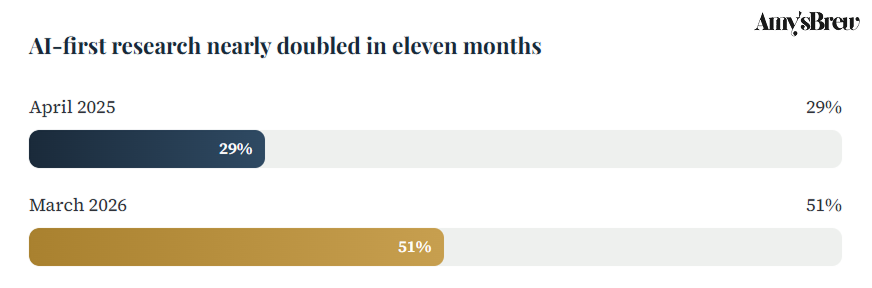
Share of B2B software buyers who start research with an AI chatbot more often than Google. Source: G2, “The Answer Economy: G2’s 2026 AI Search Insight Report,” n=1,076.
The shift runs deeper than where research starts. 71% of buyers now use an AI chatbot somewhere in their software research process, and 93% say AI chatbots have fundamentally changed how they research at all (G2, 2026).
The starting point hasn’t just shifted. It’s split.— G2, The Answer Economy (2026)
That split has teeth. 69% of buyers ended up choosing a different vendor than they originally planned once an AI chatbot weighed in, and a third of them bought from a company they’d never even heard of before that conversation (G2, 2026).
A shortlist that used to take a buying committee two weeks to assemble now takes one prompt.
Why Ranking #1 on Google No Longer Guarantees Anything
A page can hold the #1 spot on Google for its exact target keyword and still never appear in the answer ChatGPT gives to the same question.
Ahrefs (2025) tested this directly. Its researchers ran 15,000 long-tail prompts through Google, Bing, ChatGPT, Gemini, Copilot, and Perplexity, then checked how often the pages the AI assistants cited actually matched what ranked in search.
On average, only 12% of the URLs cited by ChatGPT, Gemini, and Copilot also sat in Google’s top 10 for that same query. Eighty percent of those citations didn’t rank anywhere in Google’s results for the original prompt at all.
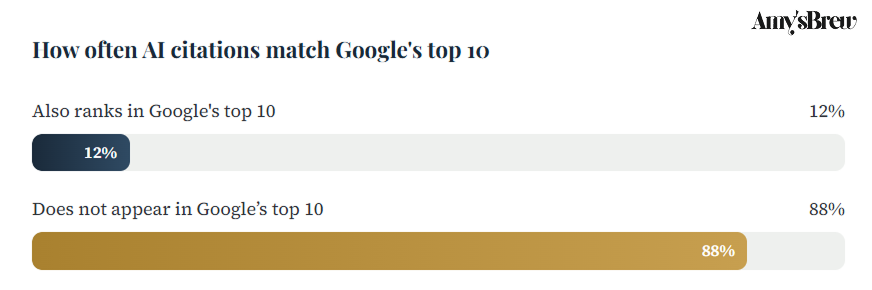
Share of AI-cited URLs that did not appear in Google’s top 10 for the same prompt, based on Ahrefs’ 15,000-prompt study. Source: Ahrefs, “Only 12% of AI Cited URLs Rank in Google’s Top 10 for the Original Prompt,” August 11, 2025.
Ahrefs (2025) found Perplexity was an outlier in its study, with nearly one-third of its citations overlapping Google’s top 10 for the target prompt. ChatGPT and Gemini aren’t.
They tend to retrieve pages through a process closer to asking the same question five different ways and favoring whichever page shows up consistently across all five, a method known as query fan-out.
Content optimized for one exact keyword phrase can miss every one of those variations.
Google and AI systems use different signals and retrieval processes, so strong Google rankings do not guarantee AI citations.
The Ahrefs (2025) study found limited overlap between AI citations and Google’s top results for the same prompts. Those are two different skills. Content built for one doesn’t automatically transfer to the other.
What Actually Earns the Citation
Being named by an AI chatbot is now the single strongest factor shaping which vendors make a B2B software shortlist, ahead of review sites, market research firms, and even a company’s own website (G2, 2026).
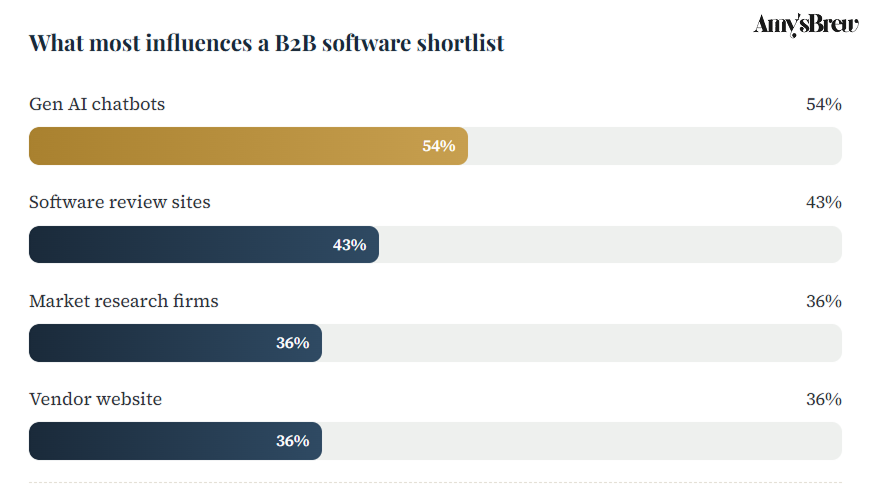
Sources B2B software buyers say most influence their vendor shortlist. Source: G2, “The Answer Economy: G2’s 2026 AI Search Insight Report.”
85% of buyers say they think more highly of a vendor once they see it mentioned inside an AI chatbot’s answer (G2, 2026). But that trust has a backstop. When an AI answer raises questions, buyers often look for evidence: 45% of B2B software buyers say a review-site citation is the most confidence-inspiring signal in an AI-generated answer (G2, 2026).
That’s the quiet mechanic behind AI visibility. Chatbots build the shortlist, but review platforms are what a buyer uses to verify it. A vendor with a thin review presence gives both the AI and the buyer less to work with.
What This Means for Your SaaS Content Strategy
Winning visibility in AI search asks for a different kind of content than winning a Google ranking, not simply more of the same SEO work.
For B2B SaaS companies selling in the US, UAE, or across international markets, the practical goal is the same: make your expertise easy for search engines, AI systems, and human buyers to understand and verify.
- Answer before you explainPut the direct answer to the buyer’s question in the first two sentences of a section, not the fifth paragraph. AI assistants pull the passage that answers a question cleanly, and they rarely wait around for a set-up.
- Write in the buyer’s words, not the keyword’sThe phrasing buyers use when typing into a chatbot is more conversational than what they’d type into Google. Match that phrasing in your headers and your answers, not just your target keyword.
- Publish something worth citingOriginal data, a genuinely useful framework, or a specific number nobody else has published gives an AI assistant a reason to point at your page instead of paraphrasing a competitor’s.
- Treat your review presence as owned contentSince review sites are the trust layer buyers fall back on, a steady stream of detailed, specific reviews is now part of your content strategy, not a separate task that sits with customer success.
- Track citations, not just rankingsA page can lose Google rank and gain AI visibility, or the reverse. Search Console won’t tell you which is happening, so start checking manually or with a dedicated AI visibility tool.
For a fuller breakdown of how SEO, AEO, and GEO differ as disciplines, see GEO vs AEO vs SEO.
Frequently Asked Questions
What’s the difference between SEO, AEO, and GEO?
SEO earns rankings on traditional search engines. AEO earns a direct answer inside an AI response. GEO is the broader practice of shaping how generative AI systems describe and recommend a brand across all of them. They overlap, but each is optimized differently. See our full breakdown in GEO vs AEO vs SEO for SaaS content strategy.
Does this mean I should stop investing in traditional SEO?
No. Google still plays a role in most B2B research journeys, and organic search remains one of the few channels a brand can measure and control directly. The point isn’t to abandon SEO, it’s to stop assuming that ranking well on Google automatically means showing up in an AI answer. They now require separate, deliberate work.
How can I tell if my content is being cited by AI chatbots?
Run your target questions through ChatGPT, Perplexity, Gemini, and Claude, and note whether your brand or content gets mentioned, and what gets cited instead when it doesn’t. Dedicated AI visibility tools can automate this at scale, but manual prompt testing is a free place to start.
Why do review sites matter so much for AI visibility?
Review platforms are some of the densest, most specific, most frequently updated sources of first-hand product detail available on the web. That makes them a natural source for AI systems looking for verifiable, real-world detail, and a natural place for buyers to double-check what an AI just told them.
How fast is this actually moving, and should I wait to adapt?
Fast enough that a strategy built around last year’s numbers is already behind. The safer approach is to treat AI visibility as an ongoing measurement, the same way you’d track Google rankings, rather than a one-time project to check off.
References
In-text citations in this article follow APA style. This article uses third-party research as evidence rather than presenting the statistics as AmysBrew’s own survey results.
- Ahrefs. (2025, August 11). Only 12% of AI cited URLs rank in Google’s top 10 for the original prompt. Ahrefs Blog. https://ahrefs.com/blog/ai-search-overlap/
- G2. (2026). The answer economy: How AI search is rewiring B2B software buying [Report]. https://learn.g2.com/g2-2026-ai-search-insight-report
Build content for both sides of the fork
Ranking on Google is no longer the whole game. If you want SaaS content built to earn both the ranking and the citation, let’s talk.