


A short guide to writing SaaS blog posts that get pulled into ChatGPT and Perplexity answers, not just ranked on a results page.
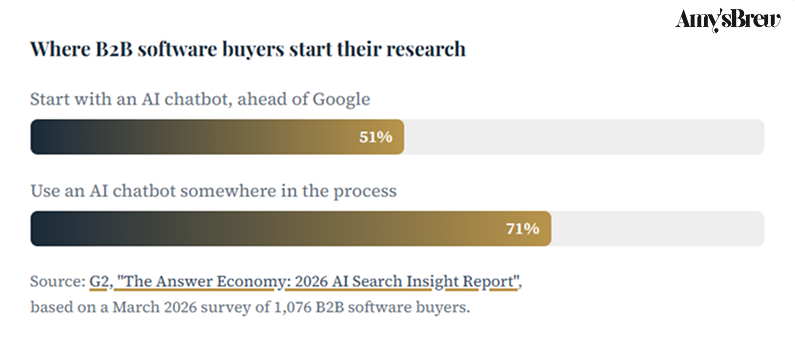
A SaaS blog can rank on page one and still lose the buyer. That’s because a growing share of research now happens inside a chat window, not a results page. G2 found that 51% of B2B software buyers now start their research with an AI chatbot instead of Google, and 71% rely on one somewhere in the process.
Ranking well for that buyer’s query does nothing if the AI answer never mentions you. Getting mentioned takes a different kind of writing. That’s what this post is about.
Key Takeaways
- AI-search-ready content is written to be quoted inside someone else’s answer, not just clicked from a results page.
- The core shift: answer first, explain second, on every section, not just the intro.
- Every claim needs a real, hyperlinked source. AI systems favor content they can verify.
- Most SaaS blogs fail this quietly by burying the answer under three paragraphs of throat-clearing.
- A single well-structured post beats a stack of thin, unsourced ones.
What Is AI-Search-Ready Content?
AI-search-ready content is written and structured so an AI system, like ChatGPT, Perplexity, or Google’s AI Overviews, can lift a clean, accurate answer from it and attribute that answer to you. It’s built for extraction, not just for ranking.
This isn’t a separate universe from SEO. It’s SEO with a second reader added: a language model deciding, sentence by sentence, whether your page is worth quoting. For the full breakdown of how this discipline splits from traditional SEO, see GEO vs AEO vs SEO.
AI-Search-Ready Content vs. Traditional SEO Content
Goal: Traditional SEO content earns a click. AI-ready content earns a citation inside an answer the reader never has to leave.
Structure: Traditional content builds toward a point. AI-ready content states the point first, then supports it.
Proof: Traditional content can lean on brand authority alone. AI-ready content needs a named, linkable source behind every specific claim.
Success metric: Traditional content is measured in rank and traffic. AI-ready content is measured in whether you show up in the answer at all.
“The brands that win in AI search are the ones that become a trusted source across a whole topic, not the ones chasing a single ranking.”
Essential Elements of AI-Search-Ready Content
- A direct answer in the first two sentences.AI systems extract early. If the answer is buried in paragraph four, it usually doesn’t get pulled.
- Subheads written as real questions.“How does X work” gets matched to queries more reliably than a clever headline.
- One sourced statistic per claim.A number without a link behind it reads as unverifiable and gets skipped.
- Short, self-contained paragraphs.Three to four lines a section, so a model can lift one cleanly without dragging in the sentence before or after.
- A named author with real expertise signals.Authority is a citation factor, not just a trust signal for human readers.
- Internal links that build a topic cluster.A single strong post rarely gets cited on its own. A cluster of connected posts does.
Why Most SaaS Content Never Gets Cited
The answer is buried. Three paragraphs of scene-setting before the actual point.
No sourced data. Claims with nothing behind them to verify.
Thin authority signals. No named author, no evidence of domain expertise on the page itself.
One-and-done publishing. A single post with no surrounding cluster to reinforce it.
Writing for the old search engine only. Optimized purely for keyword rank, with nothing that answers a spoken-language question directly.
Worth knowing: ranking and citation are increasingly separate games. Ahrefs found that, on average, only 12% of the links cited by ChatGPT, Gemini, and Copilot also appear in Google’s top 10 for the same prompt. A page can be invisible to AI search while still ranking well.
Two Quick Examples
A feature comparison post
Not ready: Opens with a paragraph about the company’s mission, then a general intro to the category, before finally comparing anything.
Ready: Opens with a one-sentence verdict on which tool wins for which use case, then a scannable comparison table, then the reasoning.
A how-to guide
Not ready: A wall of narrative prose with no numbered steps, so there’s nothing clean for a model to extract.
Ready: Numbered steps, each with a bolded action and a short explanation, so any single step can be lifted and quoted on its own.
How to Write AI-Search-Ready Content
- Answer the query in the first two sentences.Write the direct answer before you write the setup.
- Structure with real subheads.Each H2 should be a question a buyer would actually type.
- Back every claim with a live source.Link the source name, not the number, and use each source once.
- Add an FAQ section that mirrors real queries.This is often what gets pulled into AI Overviews directly.
- Publish, then track citations, not just rankings.Rank tracking alone won’t show you whether AI systems are quoting you.
Frequently Asked Questions
What does “AI-search-ready” actually mean?
It means the content is structured so an AI system can extract a clean, accurate answer and attribute it to you, not just written to rank on a results page.
Is this different from regular SEO content?
It’s an extension of it. The keyword and technical fundamentals still matter. The addition is writing for a second reader: a model deciding whether to quote you.
Do I need any special tools to get cited by AI?
No plugin makes this happen. It comes down to how the content itself is written and sourced, plus the authority signals around it.
Is this worth doing for a small SaaS blog?
Yes, arguably more so. Smaller sites can’t out-rank the largest incumbents on volume alone, but a tightly structured, well-sourced post can still get pulled into an AI answer on its merits.
Need content built for how buyers actually search now?
AmysBrew writes and structures SaaS content to be cited, not just ranked. If your blog is getting traffic from Google but going quiet in AI search, that’s usually a structure problem, not a writing problem.



Leave a Comment