SEO Agency vs. In-House Team for SaaS: Which Model Fits?
Should a SaaS company hire an SEO agency or build the function in-house? The answer depends less on which model is supposedly best and more on where your current bottleneck sits.
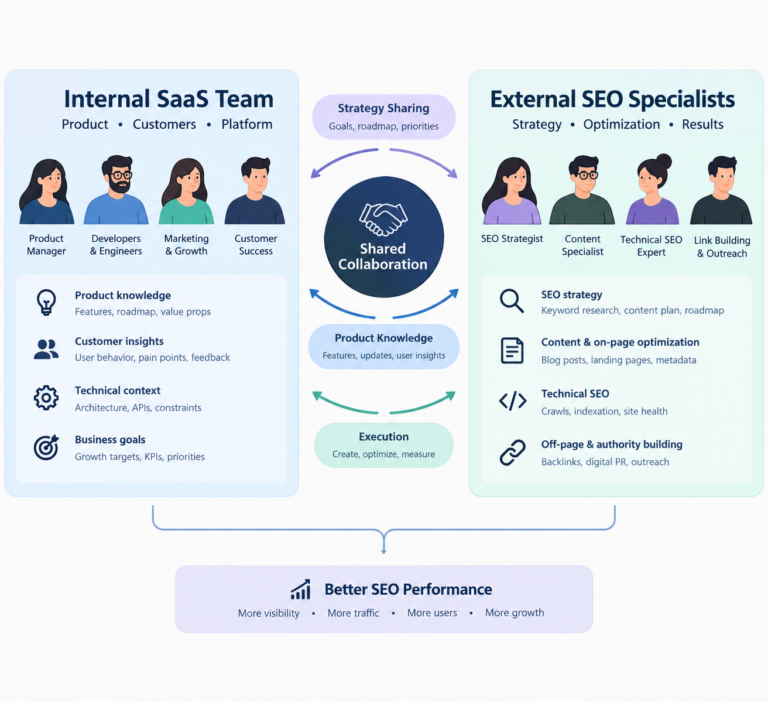
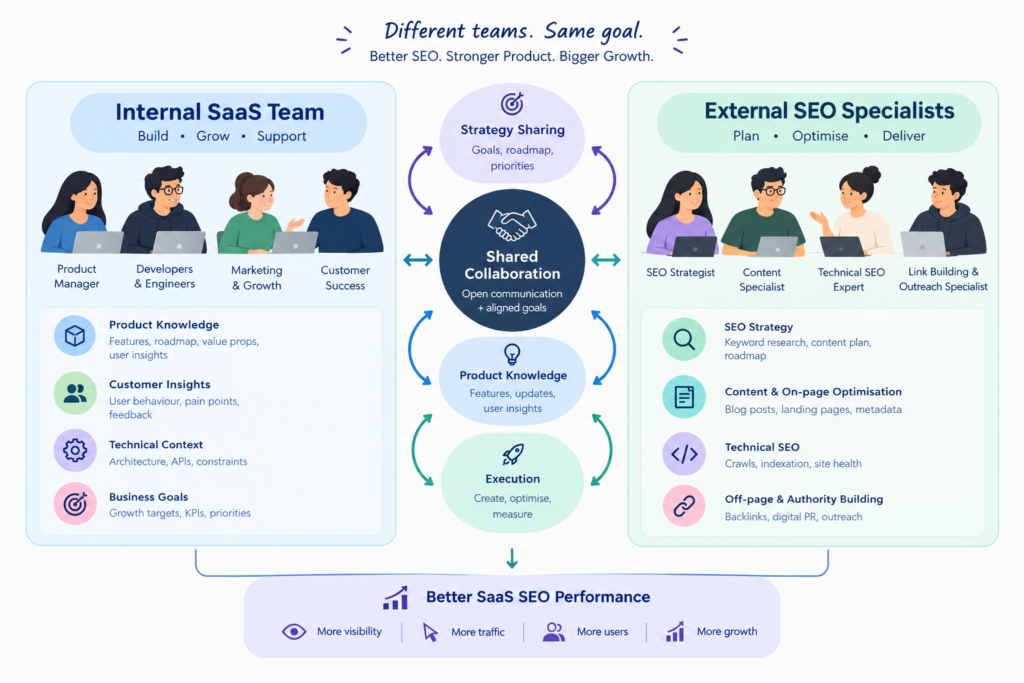
An internal SEO lead can build deep product context and work closely with product marketing, sales, and engineering. An agency can bring specialist skills, a repeatable process, and execution capacity without waiting for several hires. A hybrid model can combine both: internal ownership and product expertise, supported by external strategy or production.
The wrong model is the one that leaves your most important work without an owner. A brilliant strategy cannot help much if no one can implement it. A large content output can also miss the mark if nobody understands the product or buyer. Before making a hiring decision, map the work that needs to happen, the skills you already have, and the responsibilities nobody currently owns.
The work that a SaaS SEO function may need to cover
SEO for a SaaS company can include more than keyword research and blog writing. Depending on the business, the work may include:
- Researching customers, competitors, and search demand.
- Building a content plan by buyer stage and commercial priority.
- Improving site structure, internal links, indexation, templates, and technical performance.
- Creating product pages, use cases, integration pages, comparisons, alternatives, and educational content.
- Coordinating subject-matter review so technical details are accurate.
- Publishing and maintaining content in the CMS.
- Reviewing how buyers discover and describe the brand in AI search experiences.
- Building authority through relevant mentions, digital PR, and expert contributions.
- Measuring qualified visits, conversions, and organic influence on pipeline.
Not every company needs all of these at the same time. The point is to list the work before choosing a staffing model. Otherwise, a job description or agency proposal can sound complete while leaving an important capability uncovered.
When an in-house SEO team makes sense
An internal hire or team may be a strong fit when organic growth is a sustained priority and SEO needs to be closely embedded in company decisions. Internal staff can build product knowledge over time, hear customer questions directly, understand launch schedules, and work inside the company’s planning and approval systems.
In-house ownership is especially useful when SEO depends on frequent coordination with product, engineering, analytics, and sales. For example, a technical change may require developer time; a new feature may change product messaging; a comparison page may need legal or sales review. An internal lead can often spot those dependencies early and keep them visible.
However, one internal hire may not cover every specialty. A generalist might be excellent at strategy but have limited time for technical diagnostics, content editing, digital PR, analytics, and AI visibility research. A writer might produce strong content but lack access to developers or the authority to change site architecture. Hiring more people can solve the breadth problem, but it also increases cost and management overhead.
In-house makes more sense when:
- SEO is a core long-term acquisition channel, not a temporary experiment.
- The company can give the function a clear owner and decision-making access.
- Product and customer knowledge need to be applied continuously.
- Developers, writers, analysts, and subject-matter experts can support the work.
- There is enough sustained workload to justify hiring and managing the capability.
- The company wants to retain strategic knowledge and processes internally.
It may be less suitable if the company expects one person to own every SEO discipline without implementation support, or if the work is still too uncertain to define a full-time role.
When an agency makes sense
An agency can be useful when the team needs specialist capacity quickly, wants an outside perspective on its category, or lacks the bandwidth to plan and execute consistently. Rather than recruiting several people, the company can engage a partner for a defined scope and use its existing team for product context, approvals, and implementation dependencies.
The value depends on what is actually included. Some agencies focus on strategy and recommendations. Others also write, edit, publish, conduct technical work, build authority, or report on outcomes. These are different services. Ask which tasks are performed by the agency, which require your employees, and which are explicitly outside the contract.
An agency may fit when:
- There is a backlog of important work and not enough internal capacity.
- The company needs technical, content, or AI search expertise it does not have.
- Leadership wants a defined engagement before making permanent hires.
- Search strategy needs to be coordinated across content, website structure, and measurement.
- A specialist partner can work alongside a product or marketing lead who owns internal context.
An agency may be a poor fit if it cannot learn the product, relies on generic deliverables, or leaves implementation and review responsibilities unclear. Outsourcing does not remove the need for company input. The agency still needs access to product facts, subject experts, analytics, and timely decisions.
Agency vs. in-house: a practical comparison
| Decision factor | In-house team | Agency | Hybrid model |
|---|---|---|---|
| Product context | Builds deep, continuous knowledge | Learns through onboarding and collaboration | Internal knowledge plus outside execution |
| Specialist breadth | Depends on hiring and team size | Can bring several specialties through one engagement | Fill specific gaps while retaining ownership |
| Speed to start | Hiring and onboarding take time | Can often begin after access and kickoff | Fast support for selected workstreams |
| Cross-functional access | Embedded in company workflows | Requires clear meetings and approvals | Internal lead coordinates partner and teams |
| Technical implementation | Depends on engineering capacity | Scope may include audit or implementation support | Agency prioritizes; internal developers ship |
| Content production | Requires internal writers and editors | Can provide production at agreed cadence | Agency drafts; internal experts validate |
| Institutional knowledge | Stays inside the company | Must be documented and transferred | Knowledge is shared intentionally |
| Cost model | Salary, benefits, tools, recruiting, management | Retainer or project fee | Combination of headcount and partner budget |
| Accountability | Direct management and internal priorities | Contract scope and service governance | Shared plan needs one clear owner |
No column wins in every row. A small company may need external capacity because it cannot hire a full team. A larger company may still use an agency for a specialist audit or digital PR campaign. The useful question is how to close the capability gap at a cost and pace that fit the business.
Infographic placement: Insert a three-path decision tree after the comparison table. Ask: “Do we have an internal owner?”, “Can our team execute technical and content priorities?”, and “Do we need specialist capacity now?” End at “Build in-house,” “Engage an agency,” or “Combine both.” Add a note: “Choose based on your current bottleneck; this is not a universal staffing rule.”
Suggested alt text: Decision tree comparing when a SaaS company should build an in-house SEO team, hire an agency, or combine both.
The hybrid model: internal ownership with external capacity
For many SaaS companies, the practical answer is not “agency or in-house.” It is deciding which work should remain close to the product and which work benefits from an external specialist.
A workable hybrid often has an internal marketing or product-marketing owner who controls positioning, priorities, access, and approvals. The agency contributes a defined scope such as keyword and competitor research, technical audits, content strategy, writing and publishing, GEO research, or authority development. Developers implement agreed technical changes. Sales and customer-facing teams share the questions and objections that content should address.
The model can work well because it combines internal accuracy with external capacity. It can also fail if the handoffs are vague. Establish named owners for:
- Product facts and technical review.
- SEO priorities and final decisions.
- Content briefs, drafts, and approval deadlines.
- CMS publishing and page maintenance.
- Technical tickets and implementation.
- Analytics access, conversion definitions, and reporting.
- Agency feedback, scope changes, and escalation.
A simple responsibility matrix can prevent delays. For each recurring activity, mark who is responsible for doing the work, who approves it, who provides input, and who needs to be informed. It does not need to be elaborate; it needs to be understood by the people doing the work.
How to decide what should stay inside
Keep a capability internal when it requires frequent access to confidential knowledge, rapid product decisions, or day-to-day coordination. This often includes product positioning, roadmap decisions, customer research, final legal/compliance approval, and CRM definitions.
Consider external support when the work is specialized, episodic, or capacity-constrained. Examples can include a technical SEO audit, a new content architecture, a batch of product-led articles, a competitor analysis, or a digital PR initiative. The exact split should reflect your team’s skills and operating reality rather than a standard agency template.
A useful diagnostic is to ask four questions for each task:
- Does it require deep or confidential product context?
- Does it need to happen continuously or in a defined project?
- Do we have the skill and time to do it well internally?
- What dependency will block it if we outsource it?
If the first answer is yes and the third answer is also yes, internal ownership may be sensible. If the work is specialized, finite, or blocked by a skills gap, an external partner may be more efficient. When answers differ across tasks, use a hybrid model and document the split.
Compare the real cost, not just the invoice
An agency retainer is easy to see on a budget. The full cost of an internal team can be less obvious: recruiting, salary, benefits, tools, management time, onboarding, and the cost of skills the hire does not bring. Neither model is automatically cheaper.
Compare like with like. What outputs and decisions do you receive? How many hours of your team are needed for review and coordination? Are writing, implementation, publishing, and reporting included? Will you need extra vendors? What work remains with engineering? How quickly can the model start producing usable work?
Also consider the cost of delay. If technical fixes sit in a backlog for two quarters or content planning has no owner, the business is paying in missed learning and postponed execution—even if that cost does not appear as a line item.
Amy’s Brew currently publishes several monthly engagement options, from a focused SEO Foundation package to broader Growth Partner and Market Authority scopes. The inclusions and pricing may change; review the current services and pricing page before using it as a comparison. A useful first conversation should clarify what Amy’s Brew would own and what your team would need to provide.
Case example: what Amy’s Brew’s own early data can—and cannot—show
Amy’s Brew has shared a candid early account of its own search performance. In the three-month report, one article focused on AI-ready content recorded 25 impressions across closely related queries and no clicks; the site recorded five clicks overall during that period. The post discusses why those early numbers need context and should not trigger an automatic rewrite or sweeping conclusion.
This is Amy’s Brew’s own site data, not a client case study. It does not show that a particular agency model caused a business outcome, and it is not a forecast for another company. It does illustrate a useful operating principle: decide in advance which early signals you will watch, how long you will gather data, and what evidence would prompt a change.
Read Amy’s Brew’s three-month content strategy results for the source and detail. When evaluating any provider, ask to see how it distinguishes impressions and rankings from qualified visits, leads, and revenue influence.
A decision framework for your SaaS team
Use the following sequence to choose a model:
Step 1: List the work that must happen
Include strategy, technical SEO, content, publishing, AI visibility, authority, and measurement where relevant. Do not assume one person or vendor covers everything.
Step 2: Map current capability
For every workstream, identify an owner, skill level, available time, and dependencies. If nobody owns it, mark it as a gap rather than silently assigning it to “marketing.”
Step 3: Identify the bottleneck
Is progress blocked by expertise, capacity, product access, developer time, approvals, or unclear priorities? The right staffing model depends on the constraint.
Step 4: Choose internal, external, or shared ownership
Keep decision rights and sensitive context close to the business. Bring in external capacity for clear skill or execution gaps. Use shared ownership when coordination is realistic and roles are explicit.
Step 5: Set a review point
Define what you expect to learn in the first period, what outputs should ship, which dependencies must be resolved, and when the model will be reviewed. This gives both sides a fair way to assess whether the setup is working.
Questions to ask before choosing an agency
- What work will you own each month, and what is out of scope?
- Who will learn and document our product and buyer context?
- Who writes, reviews, and publishes content?
- Are technical fixes implemented or handed to our development team?
- What access and response times do you need from us?
- How do you report progress and recommend changes?
- How is knowledge documented if the engagement ends?
- What term, budget, and assumptions apply?
The answers should make your internal workload visible. If a proposal says “full-service” but does not name the division of responsibility, ask for a more specific scope.
Frequently asked questions
Is it better to hire an in-house SEO manager or an agency?
Neither is universally better. In-house is useful for continuous product context and embedded ownership. An agency can add specialist skills and execution capacity. Choose based on the work required, internal support, budget, and where progress is currently blocked.
Can one SEO manager handle all SaaS SEO?
One person can lead the function, especially at an early stage, but may not have time or expertise for every discipline. Technical SEO, product writing, digital PR, analytics, and AI visibility may require support from other employees or specialists.
When should a SaaS company outsource SEO?
Outsourcing can make sense when a company has a clear need but lacks the time, specialist skills, or production capacity internally. Define the agency’s deliverables and internal dependencies before starting.
Can an agency replace an in-house marketing team?
An agency can own a defined organic growth scope, but it still needs product context, timely approvals, and access to the people who understand the business. It does not replace internal decisions about product, positioning, compliance, or sales priorities.
What is a hybrid SEO model?
A hybrid model combines internal ownership with outside specialist support. The company keeps product knowledge and decision-making close, while an agency or consultant supports selected strategy or execution needs.
Choose around the bottleneck
The strongest setup is the one that gives important work an owner, keeps product facts accurate, and lets decisions turn into shipped improvements. If you are weighing an agency partnership against an internal hire—or trying to define a hybrid scope—review Amy’s Brew’s services and discuss your team’s needs.