AI Lead Generation for B2B SaaS: Tactics, Tools & Best Practices

Most AI lead generation guides list tools. This one explains what the tools actually do, what the research confirms, and the seven mistakes B2B teams keep making before any of it works.
Who This Guide Is For?
This guide is for B2B SaaS marketing, demand generation, revenue operations, and sales teams that already have CRM data, inbound or outbound lead flow, and a need to improve lead quality rather than simply increase lead volume.
Key Takeaways
- According to McKinsey’s State of AI 2025, marketing and sales is the number one area where AI is generating measurable revenue growth — not cost savings.
- AI lead generation success depends on strategy and data quality before any tool is selected. Most implementation failures are strategy failures, not technology failures.
- HubSpot’s own team achieved an 82% increase in email conversion rates by using AI to personalise content at the individual level rather than the segment level. The case study is published on their blog.
- The four core AI lead generation tactics that produce measurable B2B results are: predictive lead scoring, AI-personalised email, intent data targeting, and 24/7 chatbot qualification.
- AI does not replace a broken lead generation process. It accelerates a sound one. Teams that skip the data readiness and strategy steps consistently report zero measurable return.
- This guide covers the seven most common mistakes B2B teams make when adopting AI for lead generation — and what to do instead.
B2B lead generation for B2B SaaS has a quality problem, not a quantity problem. Teams generate large volumes of leads, and most of those leads never convert. Before AI entered the picture, the standard fix was to generate more leads.
The smarter approach is no longer to generate more leads. It is to qualify better, personalize earlier, and reach the right accounts at the moment they are actively researching a solution, which is precisely what AI is built to do.
Why AI Lead Generation Matters for B2B SaaS in 2026
It used to be that AI-powered lead generation was something early adopters experimented with. That window has closed.
McKinsey’s State of AI 2025 report found that 78% of organisations now use AI in at least one business function, up from 72% in early 2024. More specifically, the report identifies marketing and sales as the single function generating the most AI-driven revenue growth across industries.
Of all business functions tracked, marketing and sales consistently led on revenue-side impact from AI adoption. (McKinsey, The State of AI 2025)
The corollary is important: if the majority of your competitors are already using AI to qualify leads faster, personalise outreach at scale, and identify high-intent accounts before you do, the competitive gap is widening in real time.
The adoption gap is not in tools, it is in outcomes. McKinsey also notes that while AI adoption is broad, only one-third of organisations have begun scaling AI at the enterprise level.
Two-thirds are still in proof-of-concept or pilot phases, without a clear path from experimentation to measurable revenue impact. For B2B teams that design their AI lead generation workflows correctly from the outset, this represents a genuine first-mover window that is still open.
How AI Lead Generation Works in a B2B Sales Workflow
Before selecting any tool, it is worth being precise about what AI is and is not doing in a lead generation context. AI does not replace the sales and marketing process. What it removes are the bottlenecks that slow human teams down and the guesswork that reduces conversion rates.
At a practical level, the shift from traditional lead generation to AI lead generation looks like this:
| Traditional Lead Generation | AI Lead Generation |
|---|---|
| Manual prospect and account research | Automated account research using CRM, firmographic, and behavioural signals |
| Static lead scoring based on fixed rules | Predictive lead scoring that updates as new data arrives |
| Segment-based email nurture sequences | Individual-level personalisation based on behaviour and intent |
| Reactive inbound follow-up during business hours | Real-time chatbot qualification and routing |
| Broad outbound outreach to large lists | Intent-based prioritisation of accounts already showing buying signals |
The four areas below are where AI most directly changes the lead generation workflow.
Lead Prioritisation at Scale:
Traditional lead scoring uses static rules set by humans based on historical intuition. AI-powered scoring analyses dozens of signals simultaneously — firmographic data, engagement patterns, website behaviour, email interaction, third-party intent signals — and updates scores continuously as new data arrives.
The result is a ranked pipeline where your sales team’s first call is to the lead most likely to convert, not the lead that arrived first.
Individual-Level Personalisation:
Most email nurture sequences personalise at the segment level: “people who downloaded this content get this sequence.” AI enables personalisation at the individual level — understanding what specific job a specific person is trying to accomplish right now, and matching content to that intent.
This is the mechanism behind HubSpot’s 82% conversion rate improvement, which is documented in their published case study.
Timing: Finding Accounts in Active Buying Mode:
Intent data tools monitor online behaviour across thousands of B2B media sites and category-specific platforms to identify accounts that are actively researching solutions like yours — before they have contacted any vendor.
This shifts outreach from broadcasting to the entire addressable market to targeting the fraction that is in a buying cycle right now.
24/7 Inbound Qualification:
The gap between a prospect arriving on your website and a human rep following up is one of the most significant pipeline leaks in B2B sales. AI chatbots close this gap by qualifying leads at the moment of arrival, regardless of timezone or business hours.
Modern qualification bots ask structured discovery questions, route responses into the CRM, and book calendar slots directly — delivering a fully qualified lead summary before a human rep ever joins the conversation.
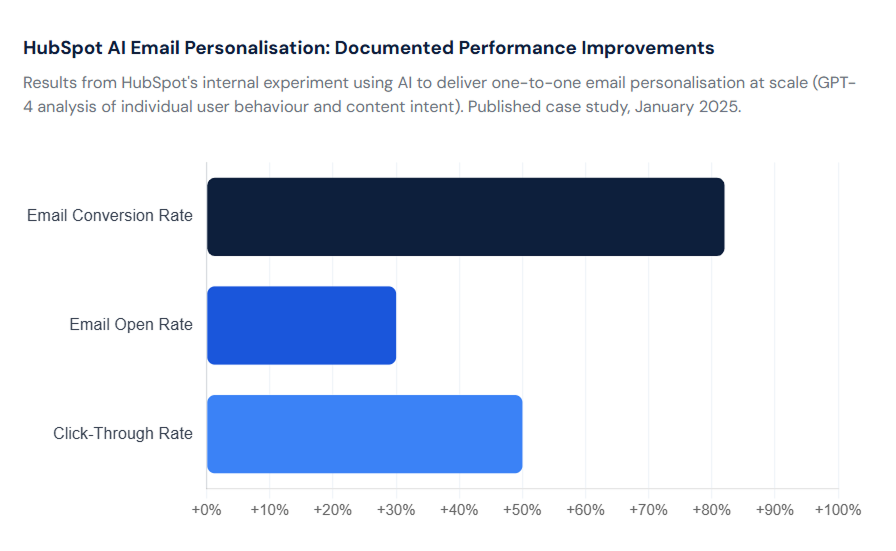
Chart 1: Documented performance improvements from HubSpot’s AI-powered email personalisation experiment. HubSpot’s demand generation team used GPT-4 to analyse individual user behaviour and match content recommendations to each contact’s specific job-to-be-done, moving from segment-level to individual-level personalisation. Source: HubSpot, “How We Used AI to Increase HubSpot Email Conversions by 82%,” January 2025.
Seven Mistakes B2B Teams Make With AI Lead Generation
McKinsey’s research is direct on this point: most organisations are not seeing measurable business impact from AI, even as adoption rises. The report found that only about one-third of companies have begun scaling AI at the enterprise level, while two-thirds remain in testing phases without a clear path to revenue impact. The reason is not the technology. It is the approach. (McKinsey, The State of AI 2025)
These are the seven implementation mistakes that consistently prevent AI lead generation from producing measurable return.
1. Selecting Tools Before Defining the Problem
The most common starting point is the wrong one. Teams research AI lead generation tools, select a platform based on features or brand recognition, and then look for a use case to apply it to. This reverses the correct sequence. The right starting point is identifying a specific, measurable bottleneck in the current pipeline — leads not being followed up in time, poor conversion from MQL to SQL, inability to personalise at scale — and then selecting a tool designed to address that specific problem.
How to fix it: Define the business outcome first. “We want to improve our MQL-to-SQL conversion rate from 8% to 14% within six months.” That objective determines which tool category is relevant before any vendor evaluation begins.
2. Deploying AI on Dirty Data
AI lead scoring, personalisation engines, and intent data platforms are only as useful as the data feeding them. If your CRM contains duplicate records, missing company data, incorrectly tagged lead sources, or historical conversion data that does not reflect current buyer behaviour, AI will learn and amplify those inaccuracies rather than correct them. This is one of the most well-documented failure modes in AI adoption and it applies directly to lead generation.
How to fix it: Audit and clean CRM data before deploying any AI scoring model. Define what a qualified lead looks like based on closed-won data, not assumptions. Ensure lead sources are accurately tagged across all channels.
3. Using AI Lead Scoring Without Closing the Loop
AI lead scoring produces a ranked pipeline. It does not automatically improve conversion unless the sales process adapts to use the ranking. Teams that deploy AI scoring but continue to work leads in chronological order, or that do not retrain the model based on actual close rates, capture very little of the available benefit.
How to fix it: Establish a clear handoff protocol that routes the highest-scored leads to the fastest-responding reps. Feed closed-won and closed-lost data back into the scoring model quarterly to improve its accuracy over time.
4. Personalising Email Without Connecting to CRM Intent Data
AI-personalised email works best when it draws on individual behavioural data: which pages the contact has visited, which content they have downloaded, which emails they have opened and clicked, and how recently. Teams that use AI to vary subject lines or swap out content blocks without connecting the personalisation engine to actual behavioural signals are producing the appearance of personalisation rather than the substance of it.
How to fix it: Ensure your email platform has a live integration with your CRM and website analytics before enabling AI personalisation features. The depth of the data feed determines the quality of the personalisation output.
5. Treating Intent Data as a List, Not a Signal
Intent data tells you which accounts are actively researching topics related to your product. Its value is in timing: it identifies the accounts worth prioritising this week. Teams that treat intent data as a static list — exporting it monthly, loading it into their CRM as a segment, and running standard sequences — miss most of the benefit. Intent signals decay quickly. An account researching your category today may have made a vendor decision in three weeks.
How to fix it: Build a workflow that surfaces new intent signals to the relevant SDR or AE within 24 to 48 hours of the signal appearing, with context on what the account has been researching. The speed of the response matters as much as the personalisation of it.
6. Deploying Chatbots Without Qualification Logic
A chatbot that asks every visitor the same three questions and routes them all to “book a demo” is not qualification — it is friction. The value of an AI-powered qualification bot depends entirely on the quality of the discovery logic: what questions it asks, in what order, how it adapts based on responses, and how it hands off to a human rep.
How to fix it: Map the qualification criteria that your best sales reps use in the first ten minutes of a discovery call. Those criteria become the chatbot’s conversation logic. The chatbot should replicate good qualification, not automate bad qualification at higher speed.
7. Measuring Activity Instead of Pipeline Impact
The most common way teams report on AI lead generation results is to measure inputs: number of leads scored, emails sent, chatbot conversations initiated. These metrics say nothing about whether AI improved conversion rates, shortened the sales cycle, or increased the average deal value. Teams that measure activity instead of pipeline impact cannot determine whether their AI investment is generating return — and cannot make informed decisions about where to expand or cut it.
How to fix it: Define three pipeline metrics before launching any AI lead generation initiative: MQL-to-SQL conversion rate, average sales cycle length, and average deal value. Measure these before and after AI implementation. Everything else is a proxy.
Best AI Lead Generation Tactics and Tools for B2B SaaS Teams
With those seven failure modes addressed, the following tactical areas are where AI-powered lead generation is producing documented, measurable results for B2B teams in 2025.
| Tactic | What AI Does | Tools to Evaluate | Best Fit | Data Requirement |
|---|---|---|---|---|
| Predictive Lead Scoring | Analyses multi-signal data to rank leads by conversion likelihood, updates continuously | HubSpot Predictive Scoring, Salesforce Einstein, MadKudu | Teams with 500+ leads/month and CRM history | Clean CRM with 6+ months of closed-won data |
| AI Email Personalisation | Matches content to individual behaviour and intent rather than segment rules | HubSpot AI, Customer.io, Klaviyo AI | SaaS teams with active nurture sequences | CRM + website behavioural data integration required |
| Intent Data Targeting | Identifies accounts actively researching your category before they contact you | Bombora, 6sense, G2 Buyer Intent | ABM-focused teams, competitive markets | ICP definition; SDR workflow for rapid follow-up |
| Chatbot Qualification | Qualifies inbound leads 24/7, books meetings, routes to CRM | Drift (Salesloft), Intercom, HubSpot Chatflows | SaaS with high inbound volume, PLG motion | Clear qualification criteria defined in advance |
| AI-Assisted Outreach | Researches accounts, identifies contacts, drafts personalised first messages | Apollo.io, Clay, Outreach.io | Outbound-heavy teams; requires human review before sending | ICP definition; human approval workflow required |
Table 1: Core AI lead-generation tactics with representative tools, best-fit use cases, and data requirements. Tool recommendations are based on publicly documented capabilities and intended use cases; no commercial relationships influence these recommendations. Teams should validate data handling policies and integration requirements independently before tool selection.
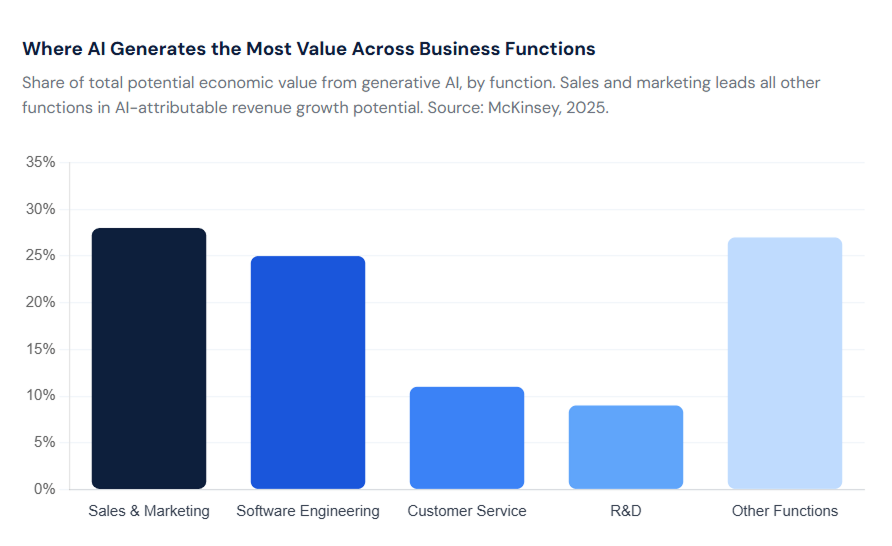
Chart 2: Share of total potential economic value from generative AI by business function. Sales and marketing accounts for 28% of total gen AI economic value potential, the highest of any single function. Source: McKinsey & Company, Superagency in the Workplace, January 2025.
How to Implement AI Lead Generation in a B2B SaaS Team
McKinsey’s research on what differentiates the organisations seeing the largest returns from AI identifies one consistent factor above all others: workflow redesign. High-performing teams do not bolt AI onto existing processes. They redesign the process around AI’s capabilities. This principle applies directly to lead generation. (McKinsey, Reinventing marketing workflows with agentic AI, 2025)
For B2B SaaS companies building an AI lead generation capability from the ground up, the following sequence reduces risk and accelerates time-to-measurable-result.
Data Foundation First
Before selecting any AI tool, clean the CRM. Resolve duplicate records, ensure lead sources are accurately tagged, and identify which closed-won deals share the characteristics you want AI to learn from. This work is not glamorous, but it determines the ceiling on every AI model you deploy.
Start With Predictive Lead Scoring
If you are on HubSpot or Salesforce, activate the native predictive scoring feature. It requires no additional cost at most enterprise plan tiers and produces an immediate improvement over static rule-based scoring. Run it alongside your existing process for 60 days and measure whether the top-quartile AI-scored leads convert at a higher rate than your previous “hot” leads.
Test AI Personalisation on Your Highest-Stakes Sequence
Identify the nurture sequence that is most directly upstream of a demo or free trial signup. Run an AI-personalised variant against the control and measure conversion rate — not open rate — over 60 to 90 days. The HubSpot case study is a useful benchmark for what is achievable when individual-level intent data feeds the personalisation engine.
Layer in Intent Data Once Outreach Is Working
Intent data dramatically improves outreach prioritisation, but it requires a fast follow-up workflow and personalised messaging to realise its value. Deploy it after your email personalisation is proven, so you have a tested outreach system ready to act on the signals it surfaces within 24 to 48 hours.
What to measure at each stage
Stage 1 (data) — data completeness and source attribution accuracy. Stage 2 (scoring) — MQL-to-SQL conversion rate comparison between AI-scored and previously defined hot leads. Stage 3 (personalisation) — email conversion rate, not open rate. Stage 4 (intent data) — pipeline velocity and average deal size for intent-sourced accounts versus baseline. Define the baseline before deploying each stage
If you are building a broader content and SEO strategy around AI and SaaS alongside your lead generation work, these related guides on AmysBrew cover adjacent topics: the future of SaaS in 2025 examines AI’s role in reshaping software delivery models, while the analysis of AI and human work addresses the strategic workforce questions that often accompany AI adoption decisions in sales and marketing teams.
Frequently Asked Questions About AI Lead Generation
What is AI-powered lead generation?
AI-powered lead generation uses artificial intelligence to identify, score, prioritise, and engage potential customers based on data signals such as website behaviour, CRM activity, firmographics, intent data, email engagement, and buying patterns.
Unlike traditional lead generation, which often relies on static lists, manual research, and broad segmentation, AI lead generation helps B2B teams focus on the accounts and contacts most likely to convert. It can also automate tasks such as lead scoring, email personalisation, chatbot qualification, and sales outreach research.
How is AI lead generation different from traditional lead generation?
Traditional lead generation usually depends on manual prospecting, predefined audience segments, and rule-based scoring. AI lead generation is more dynamic because it analyses multiple data points in real time to identify buying intent, predict conversion likelihood, and recommend the next best action.
For B2B SaaS companies, this means sales and marketing teams can spend less time chasing low-quality leads and more time engaging high-intent prospects who are closer to making a purchase decision.
Which AI lead generation tools are best for B2B SaaS companies?
The best AI lead generation tools for B2B SaaS depend on your sales motion, CRM setup, and lead volume. Common tools include:
| Predictive lead scoring | HubSpot Predictive Scoring, Salesforce Einstein, MadKudu |
| Intent data targeting | Bombora, 6sense, G2 Buyer Intent |
| AI email personalisation | HubSpot AI, Customer.io, Klaviyo AI |
| Chatbot lead qualification | Drift, Intercom, HubSpot Chatflows |
| AI-assisted outbound outreach | Apollo.io, Clay, Outreach.io |
For most B2B SaaS teams, the best starting point is a tool that integrates directly with their CRM and supports existing sales workflows.
How much can AI lead generation improve conversion rates?
AI lead generation can improve conversion rates by helping teams prioritise better-fit leads, personalise follow-up, and respond faster to buying signals. The exact improvement depends on factors such as data quality, CRM hygiene, lead volume, sales process maturity, and how consistently the team acts on AI recommendations.
B2B SaaS companies with clean CRM data, clear ideal customer profiles, and active sales workflows are usually better positioned to see measurable improvements in lead-to-opportunity and opportunity-to-customer conversion rates.
Can a small B2B team use AI lead generation without a data science team?
Yes. Small B2B teams can implement AI lead generation without a dedicated data science function by using no-code or built-in AI features inside platforms like HubSpot, Salesforce, Apollo.io, Clay, Intercom, or Customer.io.
The key is to start with practical use cases, such as AI lead scoring, website visitor qualification, email personalisation, or intent-based follow-up. A small team does not need to build custom AI models, but it does need clean CRM data, a defined ICP, and a clear process for reviewing and acting on AI-generated recommendations.
What is intent data in AI lead generation?
Intent data shows when a company or contact is actively researching a topic, product category, competitor, or solution related to your business. In AI lead generation, intent data helps sales and marketing teams identify prospects who may be in-market before they submit a demo request or contact sales directly.
For B2B SaaS companies, intent data can come from sources such as review platforms, content engagement, website activity, search behaviour, third-party publisher networks, and product comparison pages. AI tools use this data to prioritise accounts, trigger outreach, and personalise messaging based on what the buyer appears to be researching.
Why is intent data important for B2B SaaS lead generation?
Intent data is important because it helps B2B SaaS teams identify buyers earlier in the decision-making process. Instead of waiting for inbound leads, sales teams can target accounts that are already showing interest in a relevant problem, category, or competitor.
When combined with AI lead scoring, CRM data, and firmographic fit, intent data can help prioritise outreach to the accounts most likely to enter a sales cycle. This is especially useful for account-based marketing, competitive markets, and outbound sales teams.
Need Research-Backed AI and SaaS Content That Ranks?
I write research-backed, long-form SEO content for SaaS, AI, fintech, and tech brands — content built on real data, real sources, and a process that consistently ranks on Google and converts B2B buyers into leads.
View Services & Pricing